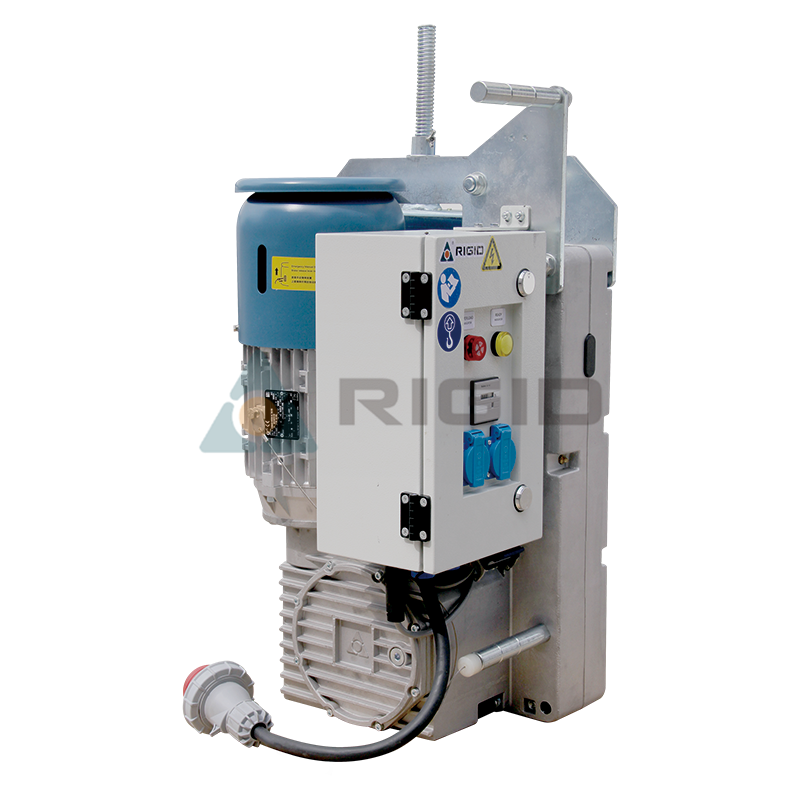
Elevator Climber (Power Climber) Selection: Brake, Motor, And Capacity Engineering
What Is an Elevator Climber and Why Is It Different From a Traction Hoist?
An
elevator climber is a rail-engaged lifting machine designed for scaffoldless installation, while a traction hoist is a rope-and-sheave machine designed for permanent car operation. Conflating the two leads to mis-specification: a climber must climb the rail with positive engagement at every tooth; a traction hoist must transmit force through rope friction without slip.
The structural distinction matters. A climber carries its load on a pinion that engages with the guide-rail teeth (or on a rope wrapped around a sheave that is itself anchored to the rail). A traction hoist carries its load on wire ropes passing over a traction sheave. The climber is bolted to the rail via a saddle or adapter plate; the traction hoist is anchored to the machine beam in the hoistway or on the car roof.
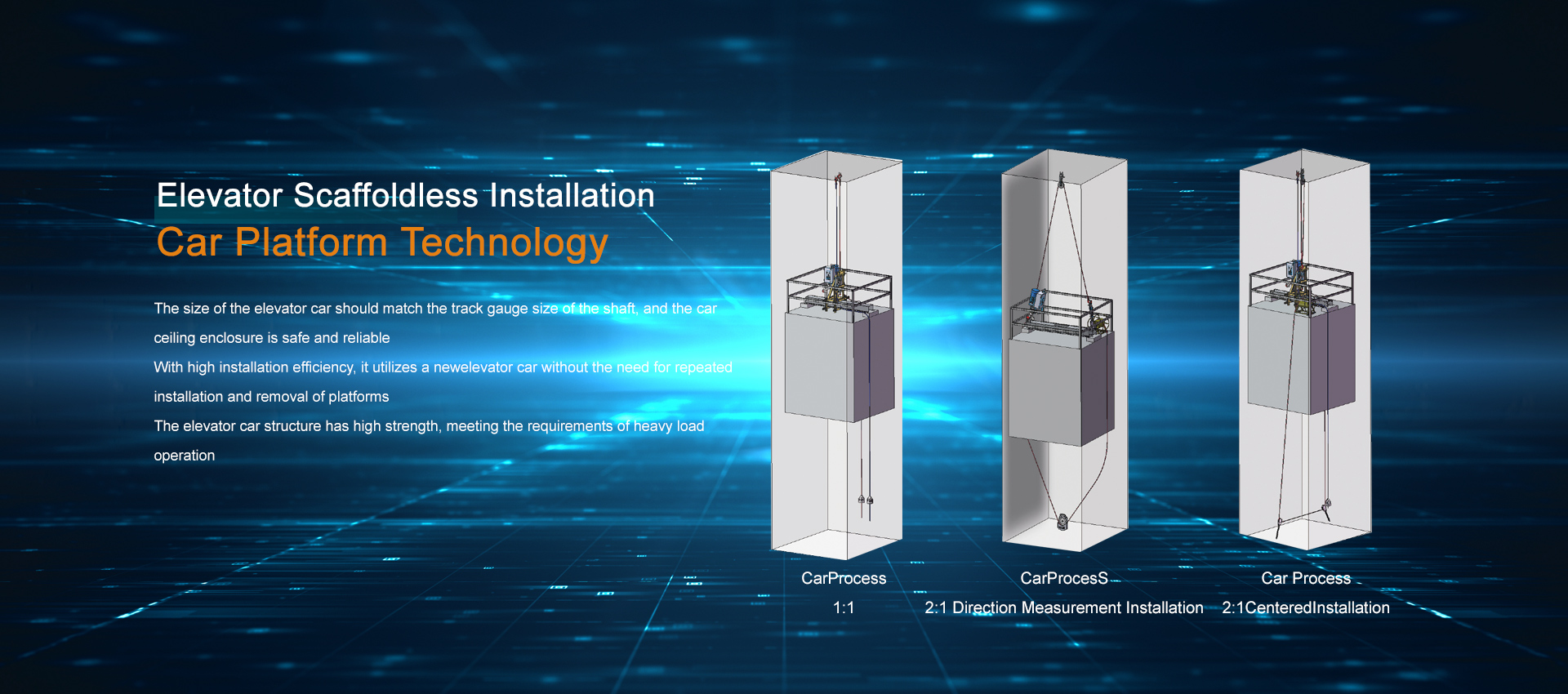
In scaffoldless elevator installation, the climber is the primary lifting device during shaft work, replacing the traditional scaffold. It travels up the guide rail as the rail is erected, lifting crews, tools, and rail sections. Once the permanent elevator equipment is installed, the climber is removed from the shaft and redeployed to the next job site.
What Are the Three Independent Specification Decisions?
Brake holding torque, motor continuous rating, and rated capacity are independent decisions; failing to treat them independently is the most common procurement error. Each addresses a different failure mode.
|
Decision |
What it specifies |
Failure mode it prevents |
|
Brake holding torque |
Static holding force with motor de-energized |
Runaway descent under load during a power loss |
|
Motor continuous rating |
Continuous power output at the rated duty cycle |
Thermal overload during sustained climbs |
|
Rated capacity |
Maximum payload at the rated duty cycle |
Structural overload and tooth breakage |
Selecting on the headline capacity alone — for example, choosing a 1000 kg climber because the heaviest rail section weighs 400 kg — leaves the brake and motor undersized. The right specification picks each parameter against the duty cycle and the safety factor required by the standard.
What Brake Holding Torque Is Required?
Service brake holding torque must exceed the worst-case static load with the standard safety factor, and the secondary (parking) brake must be independent of the service brake. The standard rule for installation hoists is a minimum 1.5× safety factor on static load, applied to a single brake; for redundant dual-brake systems the safety factor is often shared across both brakes but never below 1.25× on either.
Brake selection starts with the load:
Static load at the climber = mass × gravity × safety factor (typically 1.5).
Required torque = static load × effective sheave/pinion radius.
Required torque must be met by the spring-applied brake, not by the motor's regenerative braking.
Spring-applied, electrically released brakes are the industry default because they fail safe: if power is lost, the brake engages and holds the load. The brake's torque rating is established by the manufacturer at a specific air gap and lining condition. Periodic brake inspection verifies that the actual torque has not degraded.
|
Brake type |
Holding principle |
Reset after wear |
|
Spring-applied, electrically released |
Mechanical spring force |
Manual or automatic adjustment of air gap |
|
Hydraulic thrustor |
Hydraulic pressure on caliper |
Seal replacement, fluid flush |
|
Permanent magnet |
Magnetic force from permanent magnet |
Demagnetization check (rare) |
|
Disc brake |
Caliper clamping on disc |
Pad replacement, rotor thickness check |
The Wuxi Rigid Elevator Climber platform specifies dual independent brakes on each unit: one service brake and one parking brake. The redundancy is a hard requirement for personnel-carrying duty.
How Is the Motor Continuous Rating Sized?
The motor must be sized for the continuous duty of the planned climb profile, not for the average load. Installation climbs are intermittent: lift a rail section, hold for crew work, descend, repeat. The motor must deliver the climb torque continuously without exceeding its thermal limit.
Duty classification matters. A motor rated for S2 (short-time) duty can deliver high torque for tens of seconds; a motor rated for S3 (intermittent periodic) duty is specified by a duty cycle (e.g., 25% on, 75% off); a motor rated for S4 or S5 must be evaluated against the actual start-stop pattern.
For installation climbers, the realistic duty pattern is:
30–45 seconds climbing at full torque (lifting rail section).
60–180 seconds of holding or static work (crew landing the rail).
15–25 seconds descending (empty or partially loaded).
Pause, reposition, repeat.
This pattern — typically a 15–20% effective duty cycle — is well within S3 intermittent ratings of standard industrial motors. The common error is to specify an S2 short-time motor for an S3 intermittent application; the motor appears to work but its thermal reserve is exhausted before the work day ends.
|
Motor class |
Typical use |
Limitation |
|
S1 continuous |
Permanent elevator hoist |
Cannot deliver high torque for long climbs |
|
S2 short-time |
Bridge crane travel, point moves |
Overheats on sustained climbs |
|
S3 intermittent |
Installation climber (best fit) |
Must respect the duty percentage |
|
S4/S5 with start-stop |
Heavily cycled industrial service |
More expensive, larger |
A second motor decision is the brake motor (a motor with the brake integrated into the non-drive end housing) versus separate motor and brake. Brake motors simplify the mechanical package and reduce alignment errors; separate components give finer control over each parameter.
What Capacity Margin Should Be Specified?
Rated capacity should exceed the heaviest planned lift by at least 50%, with an additional safety factor for personnel lifts. Personnel-carrying duty in most jurisdictions requires a 2.0× safety factor on the static load; material-only lifts may be acceptable at 1.5×.
The capacity margin is consumed by:
The actual mass of the rail section or load (always check the heaviest single item).
The dynamic amplification from start-stop transitions (typically 1.1× to 1.3×).
The wind load on a partially exposed climber in an open-top shaft (site-specific; can add 5–15% on tall open shafts).
The sloshing or swinging of slung loads (relevant for tool trays, not for rigid rail lifts).
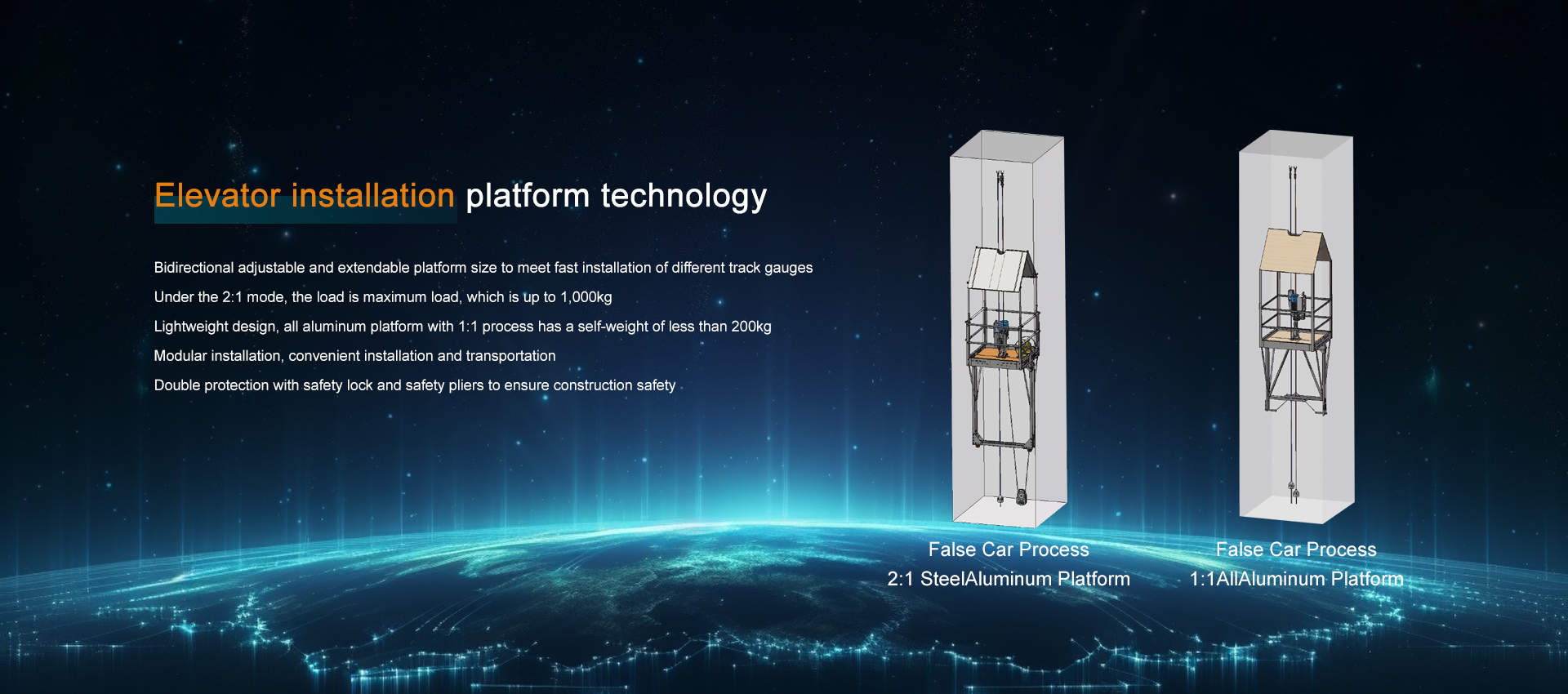
A 1000 kg rated climber should not be asked to lift 800 kg rail sections with two crew members on the platform continuously; the standard reserves the margin for the foreseeable variations. The Wuxi Rigid FC1000 and FC400 false-car platforms and the corresponding climbers are sized for typical 6–10 person installation crews plus their tools.
How Are Capacity, Speed, and Power Related?
Power equals load times speed divided by mechanical efficiency; the slowest specification is usually the most dangerous one to ignore. A climber that can lift 1000 kg at 9 m/min needs 1.5 kW at the pinion (assuming 80% efficiency); a climber that must lift 1000 kg at 18 m/min needs 3 kW. Halving the speed halves the required motor power.
Installation climbers typically run at 7–12 m/min, which is slow enough for crew comfort and precise rail alignment but fast enough to keep cycle times short. A faster climber is not always better: at higher speeds, the dynamic loads on the rail and the climber's mechanical components increase, and the crew has less time to react during descent.
The relationship is:
Required motor torque × angular speed = required mechanical power at the pinion.
Required electrical power = required mechanical power / motor efficiency.
Motor nameplate rating must exceed required electrical power by the service factor (typically 1.15 for continuous, 1.5 for intermittent).
The Wuxi Rigid Elevator Climber range pairs 1.5 kW to 4 kW motors with 1000 kg to 1500 kg capacities and 9 m/min typical climb speeds. Smaller climbers are available for confined shafts where rail-to-wall clearances preclude full-size equipment.
What Standards Govern Climber Selection?
Climber selection is governed by the personnel-lift standard that applies in the jurisdiction, not by the manufacturer's marketing literature. Standards establish the safety factor, the brake redundancy, the inspection frequency, and the operator training requirement.
|
Standard |
Region |
Coverage |
|
EN 1808 |
EU |
Suspended access equipment; climber-as-platform |
|
ANSI A10.28 |
USA |
Personnel platforms suspended from hoists |
|
GB 19154 |
China |
Hoist platforms with suspended personnel |
|
AS 1418.10 |
Australia |
Personnel lifts on construction sites |
|
CSA B354.4 |
Canada |
Aerial work platforms (related) |
The Wuxi Rigid climbers are documented to EN 1808 and to the relevant GB standards; the Authentication page lists current certifications. Procurement teams should request the certificate set that matches the destination country's standard, not assume a global "compliance" claim.
How Is a Climber Matched to the Shaft and the Rail?
The climber must be matched to both the rail profile and the shaft geometry; a climber that fits the rail may still fail to fit the shaft. Two separate compatibility questions:
Rail-to-climber fit. The pinion or saddle geometry must match the rail. Different rail sizes (T89, T90, T114, T127, T140, T150, T127-1B, etc.) require different adapter plates or interchangeable saddles. The Wuxi Rigid adapter plate range addresses this with a family of plates designed for the most common rail profiles used in Chinese and international projects.
Shaft-to-climber fit. The climber's overall envelope must clear the shaft walls, the sill, the pit, and any permanent fixtures. A climber that fits the rail but is wider than the shaft cannot be installed.
A site survey should record:
Rail size and profile at every rail joint.
Clear shaft width and depth at the narrowest section.
Pit depth and overhead clearance.
Position and size of any mid-shaft fixtures (springs, brackets, cable trays).
Power supply availability and voltage (3-phase 380 V, 415 V, 480 V, 220 V).
What Power Supply Is Required?
Most installation climbers require 3-phase power at the site's standard industrial voltage; single-phase operation is possible only on the smallest units and at reduced capacity. A 3-phase motor delivers smoother torque and better starting performance than a single-phase motor, which matters when starting a fully loaded climb.
|
Region |
Standard industrial voltage |
Phase |
Hz |
|
China |
380 V |
3 |
50 |
|
EU |
400 V |
3 |
50 |
|
USA |
480 V |
3 |
60 |
|
Australia |
415 V |
3 |
50 |
|
Site generator |
380–415 V |
3 |
50 / 60 |
Voltage mismatch is the single most common cause of climber failure on international projects. The Wuxi Rigid climbers are offered with multi-voltage motor options; the Steel Transportation Box ships with the motor configuration pre-set to the destination country.
How Are Brake Tests and Verification Documented?
Every climber installation must produce a brake test record, a no-load function test, and a loaded function test before personnel are permitted to ride. Documentation is the legal proof that the equipment was verified, not the act of testing itself.
Standard documentation includes:
Brake torque test: load the climber to 1.25× rated capacity, de-energize the motor, verify the brake holds for at least 5 minutes without drift.
Overspeed trip test: with the climber at 80% of rated capacity, drive it past the rated speed and verify the overspeed safety lock trips (the Safety Lock and the OSL30/OSL50/OSL70 series cover this).
Limit switch test: verify the upper and lower travel limits cut power and apply the brake.
Daily functional test: load, climb, hold, descend — verify normal operation.
The site file should retain the test records for the duration of the climber's deployment on that site, plus a transfer record when the climber is moved to the next site.
What Are Common Selection Errors?
The most expensive selection errors are made by treating the climber as a single rating rather than as a system of brake, motor, capacity, and geometry. Five errors recur:
Headline-capacity only. Choosing a climber because its rating exceeds the heaviest load, without checking the motor and brake against the duty cycle.
Wrong voltage. Ordering a 380 V climber for a 480 V site, or a 50 Hz climber for a 60 Hz grid.
Wrong rail profile. Ordering the standard saddle for a T127 rail when the project uses T89 rails.
Insufficient margin. Specifying 1.0× capacity margin for personnel lifts where the standard requires 1.5× or 2.0×.
Single brake. Accepting a climber with only one brake because it is cheaper — fails the personnel-lift standard in most jurisdictions.
Each error is preventable by reading the standard, by performing the site survey, and by asking the manufacturer for a written confirmation of compliance to the destination country's personnel-lift standard.
How Does Wuxi Rigid Support Climber Selection?
Wuxi Rigid Machinery supports climber selection with model-specific data sheets, adapter plate compatibility tables, and certificate documentation matched to the destination country. The engineering team can size a climber to a specific shaft from drawings and a duty-cycle description.
The procurement team should request:
Climber data sheet with motor, brake, capacity, speed, and voltage specifications.
Adapter plate compatibility list for the project's rail size.
Certificate copies (Authentication) for the destination standard.
Recommended spare parts list for the planned deployment duration.
Operator manual in the destination country's working language.
The Steel Transportation Box is the standard shipping crate for the climber, the adapter plates, and the operator manual, ensuring all parts arrive together at the site.
Frequently Asked Questions
Q: What is the difference between an elevator climber and a traction hoist?
A: An elevator climber is a rail-engaged lifting machine used during scaffoldless elevator installation to carry crew and materials up the guide rail. A traction hoist is a rope-and-sheave machine used for permanent elevator operation once the elevator is commissioned. They serve different phases of the elevator's lifecycle and have different brake, motor, and roping configurations.
Q: What brake safety factor is required for a personnel-carrying climber?
A: Most standards (EN 1808, ANSI A10.28, GB 19154) require a minimum 1.5× static safety factor on a single brake or a combined 1.25× on each of two independent brakes. Some high-risk applications specify 2.0×. The climber's brake must hold the rated load for at least 5 minutes with the motor de-energized and without measurable drift.
Q: Can a single-phase climber be used on a construction site?
A: Single-phase climbers are available for small units (typically under 500 kg rated capacity), but they deliver lower starting torque and poorer speed control than three-phase units. For personnel lifts above 500 kg, three-phase power is the standard. Site generators should be sized for the climber's locked-rotor current plus the auxiliary loads.
Q: How is climber capacity tested on site?
A: The climber is loaded with calibrated test weights to 1.25× rated capacity. The brake is engaged, the motor is de-energized, and the load is observed for 5 minutes. The climber must show no measurable drift. A second test loads the climber to its rated capacity and operates it through a full climb-descent cycle under load.
Q: What rail sizes do Wuxi Rigid adapter plates cover?
A: The Wuxi Rigid adapter plate family covers the most common guide-rail profiles used in Chinese and international elevator projects, including T89, T90, T114, T127, T127-1B, T140, and T150. Custom adapter plates can be manufactured for non-standard rail profiles on request. The adapter plate product page lists the current coverage.
Q: How often must the climber brake be inspected?
A: Most standards require a daily functional test by the operator and a periodic inspection by a trained inspector at intervals not exceeding 30 days. The brake's torque output is verified by a load test at the periodic inspection. The inspection records are retained in the site file.
Q: Can two climbers be used in tandem for heavier loads?
A: Tandem operation is possible with synchronized hoists and a load-sharing bar, but it requires explicit engineering review, dual brake verification on each climber, and operator training specific to tandem lifts. Most projects avoid tandem work by selecting a single climber with adequate capacity margin.
Q: What happens if the site voltage differs from the climber's nameplate voltage?
A: Under-voltage reduces motor torque (torque scales with the square of voltage); over-voltage increases current draw and heating. A 380 V climber on a 415 V site will run hot and may trip its overload. A 480 V climber on a 380 V site will stall on start. Voltage-matched motors or autotransformers are the only safe corrections; rewiring the motor's internal connections is acceptable only if the nameplate explicitly supports the alternate voltage.
Conclusion
Elevator climber selection is a three-axis decision: brake holding torque, motor continuous rating, and rated capacity margin. Treating any one of these as a footnote produces a climber that meets the headline specification but fails the duty cycle or the standard. Wuxi Rigid Machinery supports the decision with documented Elevator Climber data sheets, adapter plate compatibility tables, Safety Lock integration for overspeed protection, and Authentication certificates matched to the destination standard. The right climber is the one that fits the rail, fits the shaft, fits the duty cycle, and meets the personnel-lift standard in force at the project location.










 +86 51068080177


 Current location:Home
>News
>Industry news
Elevator Climber (Power Climber) Selection: Brake, Motor, And Capacity Engineering
Current location:Home
>News
>Industry news
Elevator Climber (Power Climber) Selection: Brake, Motor, And Capacity Engineering