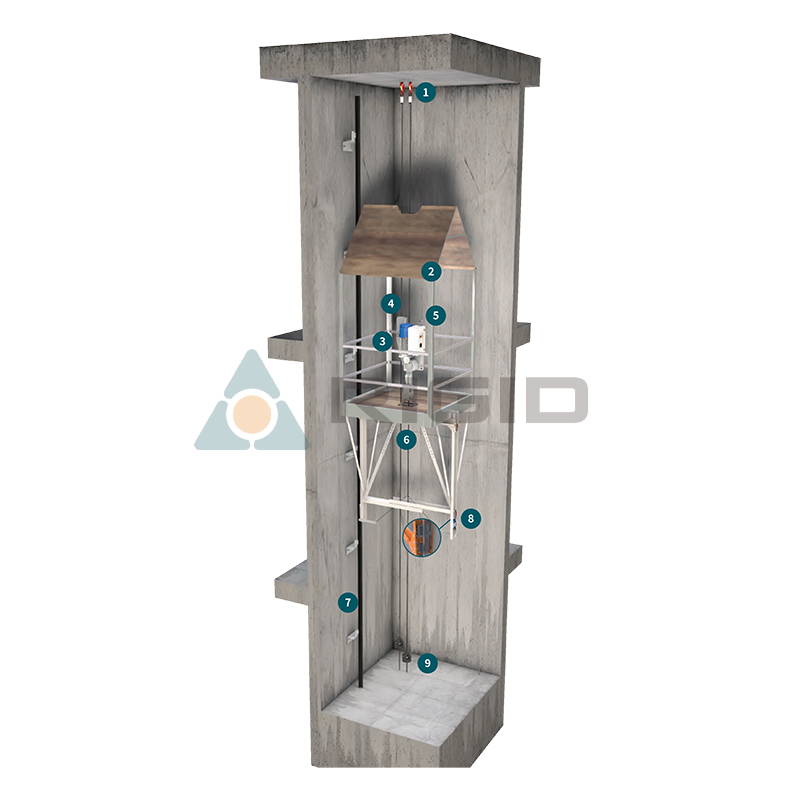
Adapter Plates And Brackets For False-Car And Climber Installation
What Is an Adapter Plate on a False-Car or Climber Installation?
An adapter plate is the bolted structural transition between the
false-car platform (or climber) and the guide rail it engages with. It converts the platform's standardized mounting pattern into the specific bolt-hole geometry, fishplate interface, or saddle geometry of the project's rail profile.
Without the adapter plate, every false-car platform would need to be rail-specific. With the adapter plate, the platform is rail-agnostic and the project-specific geometry lives in the plate — a small, inexpensive component that is replaced when the platform moves to a different rail profile.
The same principle applies to climber-to-rail engagement: the climber's saddle bolts to an adapter plate matched to the rail, and the adapter plate is the disposable interface.
What Loads Must the Adapter Plate Carry?
Adapter plates must carry the full vertical, horizontal, and dynamic loads transmitted between the platform or climber and the rail, with the same safety factor as the platform structure itself. Adapter plates are not secondary components; they are part of the primary load path.
|
Load type |
Source |
Magnitude (typical) |
|
Vertical (static) |
Mass of platform, climber, payload |
1000–3000 daN |
|
Vertical (dynamic) |
Start-stop acceleration |
1.1–1.3× static |
|
Horizontal (lateral) |
Wind, crew movement, rope tension reaction |
5–15% of vertical |
|
Horizontal (longitudinal) |
Brake reaction, rope tension |
5–15% of vertical |
|
Torsional |
Mis-engagement, off-center loading |
Site-specific |
The plate must carry all of these loads simultaneously in the most adverse combination, and it must do so without yielding, without permanent deformation, and without bolt-hole elongation. The Wuxi Rigid adapter plates are made from high-strength structural steel (typically Q355B / ASTM A572 Gr. 50) with machined or punched bolt patterns.
Why Are Adapter Plates Rail-Specific?
Each guide-rail profile has a unique cross-section, bolt pattern, and fishplate interface, so the adapter plate must match the rail exactly. Standard rail profiles include:
|
Rail profile |
Typical use |
Bolt spacing |
Bolt size |
|
T89 / T90 |
Light-duty passenger elevators |
50–100 mm |
M12 |
|
T114 / T127 |
Mid-duty elevators |
100–200 mm |
M12, M16 |
|
T140 / T150 |
Heavy-duty freight and high-speed elevators |
150–300 mm |
M16, M20 |
|
T127-1B |
Chinese mid-duty standard |
100 mm |
M12 |
A platform designed for T89 rails cannot engage T127 rails directly — the bolt spacing and rail-head width are different. The adapter plate bridges the gap: the platform side of the plate uses the platform's standard mounting pattern; the rail side uses the rail's standard mounting pattern.
What Are the Common Adapter Plate Types?
Wuxi Rigid's adapter family covers the most common interface configurations, with custom plates available for non-standard rails. Five common types appear across the product line:
|
Type |
Interface |
Application |
|
Saddle adapter |
Bolts to rail back, clamps to rail head |
Climber-to-rail |
|
Fishplate adapter |
Matches fishplate bolt pattern |
False-car-to-rail (permanent feel) |
|
Bracket adapter |
L-bracket spanning rail to wall |
Wall-anchored climber positions |
|
Pinion adapter |
Locates pinion relative to rail |
Climber pinion engagement |
|
Custom geometry |
Bespoke |
Non-standard rails, special shafts |
The Wuxi Rigid adapter catalogue lists the standard plates; custom geometry is offered with a lead time for one-off shafts or for rail profiles not yet covered by the catalogue.
How Are Adapter Plates Bolted to the Rail?
Adapter plates are bolted to the rail using the rail's standard fishplate bolt pattern or the rail-manufacturer's T-bolt interface, never welded. Field welding to the rail is forbidden in most jurisdictions because:
The rail is part of the permanent elevator safety system; modifying it without the elevator manufacturer's approval voids the elevator certification.
Heat-affected zones on the rail alter the steel's hardness, potentially compromising the rail's fatigue life.
Welds cannot be inspected to the same standard as the rail's original manufacturing inspection.
Bolted connections use:
High-strength structural bolts (8.8, 10.9, or 12.9 grade).
Calibrated torque wrenches for tightening (typically 70% of the bolt's proof load).
Nord-Lock or spring washers where vibration could loosen the connection.
Thread-locking compound on bolts that are not routinely re-torqued.
What Is the Difference Between Permanent and Reusable Adapter Plates?
Permanent adapter plates remain with the platform for the life of the equipment; reusable plates are moved between projects as part of the platform's deployment kit. Both types must meet the same load and safety-factor requirements, but they have different inspection regimes.
|
Property |
Permanent plate |
Reusable plate |
|
Mounted at |
Manufacturing |
Each redeployment |
|
Inspected at |
Manufacturing + annual |
Each redeployment + every 6 months |
|
Bolt-hole wear |
Not expected |
Expected; must be gauged |
|
Surface finish |
Painted or galvanized |
Galvanized for corrosion resistance |
|
Documentation |
Mating with platform's permanent file |
Per-project record |
Most Wuxi Rigid adapter plates are reusable. The platform's permanent file lists the platform's geometry; the project file lists the adapter plate's geometry and the rail it was mated to.
How Is Adapter Plate Compatibility Verified?
Compatibility is verified by three checks: rail profile match, bolt pattern match, and clearance match. A failure in any one of the three means the plate is wrong for the project.
Rail profile match. The plate's rail-side geometry must match the project's rail exactly — T89, T90, T114, T127, T140, T150, or another profile. A T89 plate on a T127 rail will not engage.
Bolt pattern match. The bolt holes on the rail side must match the rail's fishplate or T-bolt pattern. Even a 2 mm positional error prevents engagement.
Clearance match. The plate's overall envelope must not foul the shaft walls, the rail brackets, or any mid-shaft fixtures. The site survey records the minimum clearances; the adapter plate's GA drawing is checked against them.
Wuxi Rigid supplies a compatibility table with each platform that lists every supported rail profile and the corresponding adapter plate part number. The table is updated as new rail profiles are added to the catalogue.
How Are Loads Transferred Between Plate and Rail?
Loads transfer through the bolted connection in shear and bearing, with friction contributing to the clamp load on saddle-type interfaces. Each load path has a capacity that must be verified:
|
Load direction |
Transfer mechanism |
Capacity check |
|
Vertical |
Bolt shear + plate bearing on rail |
Bolt shear capacity × number of bolts |
|
Horizontal |
Friction (clamp load) + bolt shear |
Clamp load × friction coefficient |
|
Moment |
Bolt tension differential |
Bolt tension on the loaded side |
The bolt shear capacity is calculated as the bolt's cross-sectional area times its shear strength (typically 0.6× the bolt's ultimate tensile strength for design). The friction transfer assumes a coefficient of 0.3 for steel-on-steel with no special surface treatment.
What Inspection and Maintenance Do Adapter Plates Require?
Adapter plates require visual inspection before each redeployment, dimensional inspection annually, and load test at the manufacturer's recommended interval. Inspection is what keeps the plate's load-path capacity above the design threshold over its service life.
|
Inspection |
Frequency |
Inspector |
Method |
|
Visual (cracks, deformation, corrosion) |
Each redeployment |
Site crew |
Visual, with reference photographs |
|
Bolt-hole wear |
Annually |
Trained inspector |
Plug gauge or coordinate measurement |
|
Surface finish |
Annually |
Trained inspector |
Visual, thickness gauge for galvanizing |
|
Load test |
Every 3–5 years |
Manufacturer or qualified lab |
Calibrated load to 1.25× rated capacity |
A plate with visible cracks, bolt-hole elongation greater than 0.5 mm, or corrosion covering more than 10% of the surface area must be removed from service and either repaired (if the damage is local and the manufacturer approves) or scrapped.
How Do Adapter Plates Interact with Climbers and False-Cars?
The adapter plate is the single interface that defines whether a climber or false-car platform can be deployed on a given shaft. The platform side is standardized; the rail side is project-specific. The plate is what makes the difference between a one-project platform and a multi-project platform.
In practice:
A False Car FC1000 platform arrives at a site with one set of plates for the project's rail.
When the platform moves to a different project with a different rail, the plates are swapped (a 30–60 minute operation per plate pair).
The plates travel with the platform in the Steel Transportation Box, labelled by rail profile and project.
A platform deployed without the correct plates cannot be used; the crew must wait for the correct plates, or the platform must be returned to the depot. Planning ahead by listing the rail profiles on the deployment schedule avoids the wait.
What Custom Adapter Plates Are Available?
Custom adapter plates are available for non-standard rail profiles, for unusual shaft geometries, and for permanent installations where the plate becomes part of the elevator. Custom work typically takes 4–8 weeks from approved drawing to delivery.
|
Custom scenario |
Lead time |
Cost driver |
|
Non-standard rail profile |
4–6 weeks |
Drawing + machining setup |
|
Tight shaft clearance |
6–8 weeks |
Reduced envelope requires FEA |
|
Permanent installation |
4–6 weeks |
Surface finish, certification |
|
Special load (high-rise, heavy freight) |
6–10 weeks |
Higher-strength steel, more bolts |
The Wuxi Rigid engineering team accepts drawings in DXF, DWG, or STEP format; the output is a GA drawing, a finite-element analysis report (where required), and the manufactured plate with material certificates and load-test records.
How Are Adapter Plates Documented in the Site File?
Each adapter plate carries a serial plate with part number, year of manufacture, maximum rated load, and the rail profile it is designed for. The site file retains the engineering drawing, the material certificate, the load-test record, and a deployment log listing every project where the plate has been used.
Documentation includes:
Engineering drawing (general arrangement with all dimensions and tolerances).
Material certificate (mill certificate for the plate steel).
Bolt specification (grade, torque value, lubricant if specified).
Load test record (test load, deflection, residual deformation).
Deployment log (date, project, rail profile, inspector signature).
Inspection records (annual and pre-redeployment).
The Wuxi Rigid adapter catalogue includes a sample documentation pack so procurement teams know what to expect.
What Are Common Adapter Plate Errors?
Five errors recur across sites; each is preventable by following the standard deployment procedure.
Wrong rail profile. Selecting a plate for T89 when the project uses T127, because the catalogue code looked similar. Always cross-check the rail profile with the project's elevator drawings.
Mixed plates on a paired climber. Using a T89 plate on one rail and a T127 plate on the other. The platform becomes unlevel and the climber's load path becomes asymmetric.
Re-torquing without checking the bolt condition. Reusing a bolt that has yielded once; the second torque cycle will not bring the clamp load back to specification.
Painting over corrosion. Painting over pitted steel hides the corrosion but does not arrest it. The plate must be cleaned to bright metal before any coating is applied.
Skipping the annual inspection. A plate that has been deployed five times without inspection may have bolt-hole elongation that has reduced its load capacity by 10–20%.
Each of these is preventable by following the Wuxi Rigid deployment procedure and by retaining the inspection records.
Frequently Asked Questions
Q: Can a single adapter plate fit multiple rail profiles?
A: No. Each plate is manufactured to match a single rail profile because the rail's cross-section, bolt pattern, and fishplate interface are unique. Wuxi Rigid maintains a separate part number for each profile-plate combination. Universal plates that "fit most rails" do not meet the load-path safety factors required by personnel-lift standards.
Q: Are adapter plates reusable across projects?
A: Yes, most Wuxi Rigid adapter plates are designed for reuse. They are inspected before each redeployment, dimensionally inspected annually, and load-tested every 3–5 years. A plate that passes all three checks remains in service; one that fails any check is repaired (with manufacturer approval) or scrapped.
Q: What is the typical lead time for a custom adapter plate?
A: Standard plates ship from stock; custom plates take 4–8 weeks from approved drawing to delivery, depending on complexity. High-strength or non-standard geometries can take up to 10 weeks. The lead time is driven by the steel procurement, the machining setup, the surface finish, and (if required) the load test.
Q: Can adapter plates be welded to the rail in an emergency?
A: Field welding to the rail is not permitted under personnel-lift standards. Welding alters the rail's steel properties and may void the elevator's permanent safety certification. In an emergency, the platform should be parked, the rail inspected, and a bolted repair or rail replacement scheduled through the elevator manufacturer.
Q: What safety factor is required on adapter plate bolts?
A: The bolts must carry the design load with a safety factor of at least 1.5 on the bolt's proof load for personnel lifts. This typically translates to a bolt torque of 70% of the bolt's proof load, established by the bolt grade and diameter. The torque is verified with a calibrated wrench and recorded.
Q: How are adapter plates protected from corrosion?
A: Wuxi Rigid adapter plates are hot-dip galvanized for corrosion resistance. The galvanized coating is typically 80–120 microns thick. Plates that have lost more than 10% of their galvanized area are refurbished by regalvanizing or are scrapped, depending on the underlying steel's condition.
Q: What documentation ships with each adapter plate?
A: Each plate ships with a serial-numbered identification plate, an engineering drawing (GA), a material certificate, a bolt specification, and a load-test record. The site file retains these plus the deployment log and the inspection records over the plate's service life.
Q: How do adapter plates differ from climbing brackets?
A: Adapter plates are the interface between the platform/climber and the rail. Climbing brackets are the wall- or shaft-mounted anchors used when the climber must be tied back to the structure for additional stability on tall installations. The two are sometimes confused but serve different roles; both are typically specified together for tall open shafts.
Conclusion
Adapter plates are the structural interface that lets a single False Car platform or Elevator Climber deploy across multiple rail profiles and shaft geometries. Correct plate selection ensures the load path from platform to rail carries the design loads with the standard safety factor and that the platform is redeployable across the project portfolio. Wuxi Rigid supports the selection with a documented adapter catalogue, compatibility tables for common rail profiles, and engineering capacity for custom geometries. Pair the plate selection with the Steel Transportation Box deployment kit and the Safety Lock integration so the platform arrives on site ready to engage the rail.










 +86 51068080177




 Current location:Home
>News
>Industry news
Adapter Plates And Brackets For False-Car And Climber Installation
Current location:Home
>News
>Industry news
Adapter Plates And Brackets For False-Car And Climber Installation