Steel Transportation Box For Hoist And Climbing Equipment Logistics
What Is a Steel Transportation Box?
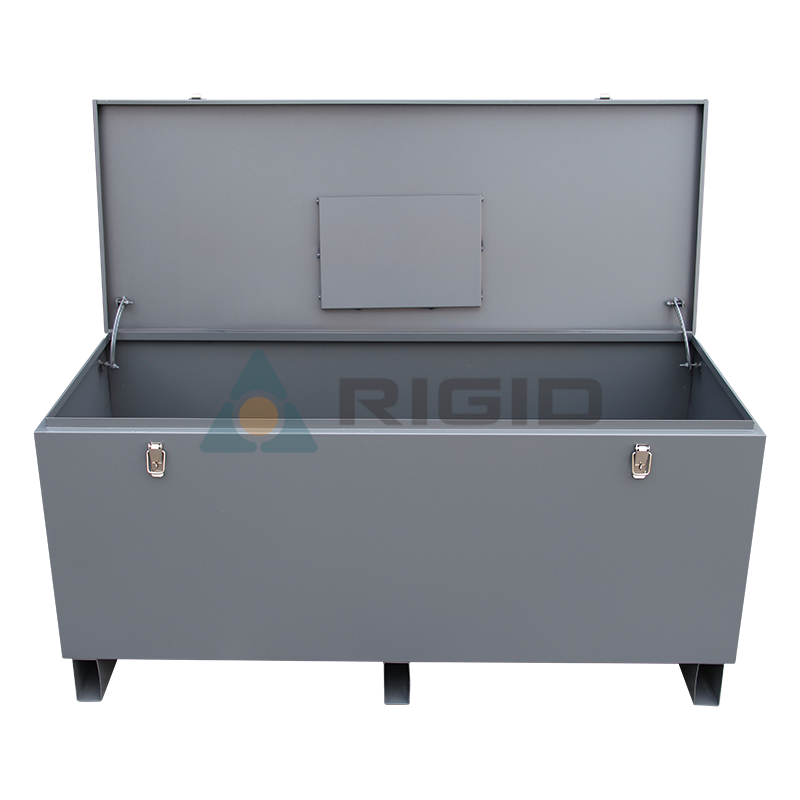
A steel transportation box is a heavy-duty reusable crate engineered to ship and store installation hoists,
climbers, and false-car components between the depot and project sites. It is not a one-way shipping crate; it is a returnable asset designed for 50+ handling cycles.
The box typically:
Is fabricated from structural steel (Q235 or Q355 grade) with welded seams.
Has forklift pockets and crane lifting points at standardized positions.
Has a hinged or removable lid with a weather seal.
Internally is fitted with rails, brackets, and tie-down points matched to the equipment's geometry.
Carries the equipment's documentation pack in a sealed document tube.
The box's design life is typically 10 years, with periodic inspection of the welds, the seal, and the lifting points.
Why Are Steel Transportation Boxes Required for Installation Hoists?
Installation hoists are moved between sites far more often than permanent elevators, and the moving and storage cycle destroys equipment faster than the actual installation work. A steel transportation box protects the equipment and reduces the lifetime cost of ownership.
Three drivers for using a box:
Repeated handling. A hoist may be moved 10–20 times in its service life. Each move exposes the equipment to impact, vibration, weather, and theft. A box mitigates all four.
Customs and regulatory inspection. A box with a sealed lid allows customs officials to inspect without exposing the equipment. The box's identification plate carries the export documents.
On-site storage. A box can be stored outdoors for the duration of the project. The weather seal keeps rain, dust, and salt spray off the equipment.
Wuxi Rigid's Steel Transportation Box range is engineered for each of the Wuxi Rigid product families, with internal fitments matched to the equipment's geometry.
What Loads Must the Box Carry?
The box must carry the equipment's weight plus handling loads from forklifts, cranes, slings, and the impact of drops and collisions during handling. The design load is typically 1.5× the equipment's mass, applied with a 1.25× dynamic factor.
|
Load case |
Magnitude |
Direction |
|
Static equipment load |
Equipment mass (1000–3000 kg) |
Vertical |
|
Forklift handling |
1.5× static |
Vertical, lateral |
|
Crane lift (4-point) |
1.25× static |
Vertical, with sway |
|
Crane lift (2-point) |
1.5× static |
Vertical, with sway |
|
Impact (drop 100 mm) |
5–10 g peak |
Vertical, transient |
The box is designed to absorb a 100 mm drop without permanent deformation to the equipment. The internal fitments are designed to restrain the equipment under all load cases.
What Are the Standard Box Sizes?
Wuxi Rigid's standard boxes are sized for the Elevator Climber, the LTD200 traction hoist, the LTD50-100, the MH40 / MH50 / MT50 models, the False Car FC400 / FC1000 platforms, and the adapter plates. Custom sizes are available for combined shipments.
|
Equipment |
Typical box external dimensions (L × W × H mm) |
Typical gross weight |
|
Elevator Climber |
1800 × 1200 × 1500 |
1500–2500 kg |
|
LTD200 traction hoist |
1600 × 1100 × 1300 |
1200–2000 kg |
|
LTD50-100 |
1300 × 900 × 1100 |
600–1000 kg |
|
MH40 / MH50 |
1100 × 800 × 1000 |
400–800 kg |
|
MT50 |
1100 × 800 × 1000 |
400–800 kg |
|
False Car FC400 |
2200 × 1500 × 1200 |
1500–2500 kg |
|
False Car FC1000 |
2800 × 1800 × 1400 |
2500–4000 kg |
|
Adapter plate set |
1200 × 800 × 600 |
200–400 kg |
The boxes are designed to stack two-high in a standard 40-foot container, maximizing container utilization on export shipments.
How Are Equipment and Components Secured Inside the Box?
Equipment is secured with bolted brackets, clamping rails, and tie-down straps matched to the equipment's geometry. The internal layout is engineered, not improvised.
Standard securing methods:
Bolted brackets. Welded brackets inside the box receive bolts that clamp the equipment at designated points.
Clamping rails. Adjustable rails hold cylindrical or irregular equipment in place.
Tie-down straps. Ratchet straps with ratchet mechanisms hold smaller components.
Foam inserts. Closed-cell foam inserts prevent movement of delicate components (gauges, sensors, electrical panels).
The Wuxi Rigid Steel Transportation Box range uses welded brackets matched to each piece of equipment; custom foam inserts are available for sensitive components.
How Is the Box Lifted and Moved?
The box is designed for forklift handling from four sides and for crane lifting from four lifting points at the top corners. Standard handling features:
Forklift pockets at the long sides, sized for standard forklift tines (100 × 50 mm).
Crane lifting points at the top corners, marked with the safe working load (SWL).
Slings sized to the SWL, attached with standard shackles.
Center-of-gravity marking on the box exterior to guide lifting operations.
|
Handling method |
Equipment |
Notes |
|
Forklift (4-sided) |
Standard |
Most common on site |
|
Crane (4-point lift) |
Heavy boxes |
Used when forklift access is limited |
|
Pallet jack (4-wheeled) |
Smaller boxes |
For warehouse handling |
|
Roll-on/roll-off |
Containerized shipments |
Truck or ship |
What Protection Against Weather and Contamination?
The box provides IP55-equivalent protection against rain, dust, and salt spray, with a sealed lid, gasketed access panels, and desiccant bags for humidity control. Each box ships with a small pack of silica-gel desiccant in the document tube.
Protection features:
Hinged lid with EPDM rubber gasket.
Latch with padlock hasp for tamper evidence.
Drainage holes at the lowest point, with pluggable seals.
Desiccant pack in the document tube (replace every 6 months).
External finish: hot-dip galvanized or zinc-rich primer plus topcoat.
For long-term outdoor storage (more than 3 months), the box should be placed on wooden dunnage to keep the base off the ground, and a tarpaulin cover is recommended.
What Documentation Ships Inside the Box?
Each box has a sealed document tube containing the equipment's certificates, manuals, and the project's shipping records. The document tube is welded to the inside of the box and accessible without opening the main lid.
|
Document |
Purpose |
|
Packing list |
Contents and quantities |
|
Commercial invoice |
Customs declaration |
|
Certificate of origin |
Customs preference documentation |
|
Equipment certificate (CE / GB / other) |
Regulatory compliance |
|
Test reports (load test, brake test, NDT) |
Quality assurance |
|
Operator manual (in destination language) |
Site reference |
|
Inspection log template |
Site record |
|
Spare parts list |
Procurement reference |
The document tube is sealed with a numbered seal; the seal number is recorded on the bill of lading so any tampering is detectable.
How Is the Box Inspected and Maintained?
The box itself requires periodic inspection of the welds, the seal, the lifting points, and the corrosion protection. A typical schedule:
|
Inspection |
Frequency |
Inspector |
|
Visual (lid, seal, surface) |
Each use |
Site crew |
|
Weld integrity |
Annually |
Trained inspector |
|
Lifting point load test |
Every 3 years |
Qualified person |
|
Corrosion protection renewal |
As needed (typically 5–10 years) |
Painter or galvanizer |
A box with a cracked weld, a torn seal, or a failed lifting-point test must be removed from service and either repaired (with manufacturer approval) or scrapped.
How Does the Box Integrate with Project Logistics?
The box is the unit of project logistics for installation hoist deployments; it sets the truck size, the crane capacity, and the customs declaration. Each project should plan around the box's external dimensions and gross weight.
Logistics planning items:
Truck or container size (typically a 20-ft or 40-ft container for a single project).
Crane capacity at the site (typically 5–10 tonnes for standard boxes).
Forklift capacity at the depot and the site (typically 3–5 tonnes).
Customs declaration (HS code, certificate of origin, commercial invoice).
Insurance valuation (box + equipment + transit).
The Wuxi Rigid Steel Transportation Box range is documented with all logistics parameters so procurement teams can plan the shipment accurately.
What Are Common Box Errors?
Five errors recur in the field; each is preventable with the standard procedure.
Overloading. Exceeding the box's marked SWL during forklift or crane handling. The box deforms and the equipment is damaged.
Wrong forklift. Using a forklift with insufficient capacity or with tines that do not fit the pockets. The box drops or tilts.
Open lid in rain. Leaving the lid open during a rainstorm at the site. Water enters and damages the equipment.
Skipping the weld inspection. A cracked weld goes undetected and fails under load. The box drops the equipment.
Lost document tube. The document tube is separated from the box and lost. The site has no manuals or certificates.
Each of these is preventable by following the Wuxi Rigid deployment procedure and by retaining the inspection records.
How Are Custom Boxes Available?
Custom boxes are available for non-standard equipment combinations, for special handling requirements, and for projects that ship multiple pieces of equipment together. Custom work typically takes 6–10 weeks from approved drawing to delivery.
|
Custom scenario |
Lead time |
Cost driver |
|
Non-standard equipment combination |
6–8 weeks |
Internal fitment design |
|
Special handling (e.g., helicopter lift) |
8–10 weeks |
Reinforced lifting points |
|
Project-specific consolidation |
6–8 weeks |
Larger box, custom dunnage |
|
Special finish (e.g., offshore paint) |
8–10 weeks |
Surface preparation, paint system |
The Wuxi Rigid engineering team accepts GA drawings in DXF, DWG, or STEP format; the output is a GA drawing, a structural calculation report, and the manufactured box with material certificates and load-test records.
Frequently Asked Questions
Q: Can a steel transportation box be used for ocean shipping?
A: Yes, the Wuxi Rigid boxes are designed for ocean shipping in standard 20-ft or 40-ft containers. The boxes are stackable, the lids are sealed, and the document tube carries the customs paperwork. Containerized ocean shipping is the standard export method.
Q: How long does a steel transportation box last?
A: With periodic weld inspection and corrosion protection renewal, a box has a service life of 10 years or more. The lifting points are load-tested every 3 years. Boxes that pass all inspections remain in service; boxes that fail any check are repaired (with manufacturer approval) or scrapped.
Q: Can the box be modified to fit additional equipment?
A: Yes, custom internal fitments can be added to an existing box for new equipment. The modification should be done by the manufacturer or an approved fabricator, with the structural calculation updated and the box re-certified.
Q: What is the typical lead time for a standard box?
A: Standard boxes ship from stock with a 2–4 week lead time; custom boxes take 6–10 weeks. The lead time is driven by the steel procurement, the fabrication, the surface finish, and (if required) the load test.
Q: Can the box be stacked when full?
A: Yes, the boxes are designed for two-high stacking in a container. The stacking is verified by a compression test at the factory. Stacking more than two high requires manufacturer approval and may require additional dunnage.
Q: What is the standard finish on the box?
A: The standard finish is hot-dip galvanization to ISO 1461, which provides 80–120 microns of zinc coating. For offshore or corrosive environments, an additional paint system can be applied over the galvanizing for extended life.
Q: Are the boxes returnable after the project?
A: Yes, the boxes are designed as returnable assets. The site returns the boxes to the depot after the project, where they are inspected, refurbished if needed, and loaded for the next project. Returnable logistics is the standard practice for installation hoist equipment.
Q: How is the box identified for tracking?
A: Each box has a serial-numbered identification plate with the box's gross weight, dimensions, SWL, year of manufacture, and the manufacturer's data. The serial number is used in the logistics tracking system and in the inspection log.
Conclusion
A
steel transportation box is the foundation of reliable installation hoist logistics. Wuxi Rigid Machinery's Steel Transportation Box range is engineered for the Elevator Climber, the LTD200 / LTD50-100 traction hoists, the MH40 / MH50 / MT50 models, the False Car FC400 / FC1000 platforms, and the adapter plates. Correct specification of the box's size, finish, and internal fitment protects the equipment and simplifies the customs, handling, and on-site storage processes. Pair the box selection with the Authentication certificates matched to the destination country and with the operator manual in the destination language.










 +86 51068080177



 Current location:Home
>News
>Industry news
Steel Transportation Box For Hoist And Climbing Equipment Logistics
Current location:Home
>News
>Industry news
Steel Transportation Box For Hoist And Climbing Equipment Logistics