Rail Lifting Hoist Engineering For Elevator Installation
What Is a Rail Lifting Hoist?
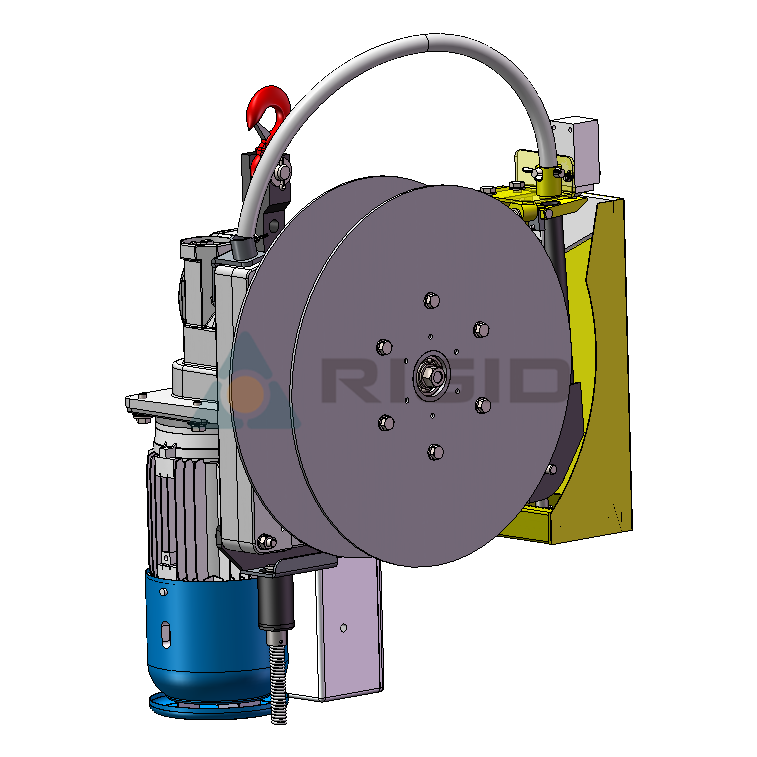
A rail lifting hoist is a dedicated auxiliary hoist used during elevator installation to lift guide-rail sections from the ground floor to the working floor, where they are landed onto the false-car platform for bolting to the shaft wall. It is faster and more precise than using the main installation hoist for rail lifts because it is sized to the rail mass, not to the car or counterweight mass.
The rail lifting hoist is typically:
Mounted on the false-car platform or on a bracket above the shaft.
Rope-driven, with a small traction sheave or a simple drum.
Powered by a single-speed or two-speed motor (typically 1.5–3 kW).
Controlled by a pendant or remote control.
Equipped with a single brake and an upper limit switch.
The Wuxi Rigid Rail Lifting Hoist range is engineered for this duty, with capacities matched to standard rail section masses.
Why Is a Separate Rail Lifting Hoist Required?
The main installation hoist is sized for the car and counterweight; using it for rail lifts is inefficient and creates a duty-cycle conflict with the main installation work. A separate rail hoist is faster, lighter, and more controllable for the specific task of lifting rail sections.
Three reasons to use a separate rail hoist:
Speed. A rail hoist runs at 12–20 m/min, faster than a car hoist (typically 9–12 m/min), because the rail section is lighter than the car.
Precision. A rail hoist positions the rail section accurately at the working floor, without the overshoot that a car hoist may exhibit at lower speeds.
Duty cycle separation. The rail hoist runs continuously throughout the rail installation phase; the car hoist sits idle during the same period. Separating the duties allows each machine to operate within its design duty cycle.
The Wuxi Rigid Rail Lifting Hoist is sized for typical T89 to T150 rail sections in 5 m lengths, which is the standard rail lift in most installations.
What Capacity Is Required?
The rail hoist capacity must exceed the heaviest rail section by at least 25%, with the lifting sling and rigging weight included in the calculation. Standard rail sections vary in mass by profile and length.
|
Rail profile |
Length |
Mass per section |
|
T89 |
5 m |
35 kg |
|
T90 |
5 m |
38 kg |
|
T114 |
5 m |
56 kg |
|
T127 |
5 m |
62 kg |
|
T140 |
5 m |
75 kg |
|
T150 |
5 m |
87 kg |
|
T127-1B |
5 m |
65 kg |
|
Heavy-duty (machined) |
5 m |
up to 120 kg |
For a typical T127 rail at 62 kg plus the sling and rigging at 8 kg, the rail hoist must lift at least 70 kg. A 100 kg capacity rail hoist provides the standard 25% margin. Wuxi Rigid's Rail Lifting Hoist range starts at 100 kg and goes up to 500 kg for heavy-duty rails.
What Speed and Cycle Time Are Required?
The rail hoist speed is set by the cycle time target — typically one rail section per 5–10 minutes, including the lift, the landing, the bolt-up, and the descent. The hoist's mechanical speed is one input; the cycle time is determined by the work at the working floor.
Typical cycle breakdown for a 30 m shaft:
Lift the rail section from ground to working floor: 1.5–2.5 minutes (at 15 m/min).
Land and align the rail: 1–3 minutes.
Bolt the rail to the brackets: 2–4 minutes.
Descend the empty sling: 1.5–2.5 minutes.
Total cycle: 6–12 minutes.
A faster hoist shortens the lift and descent phases but does not affect the bolt-up time. The Wuxi Rigid Rail Lifting Hoist range offers 12 m/min and 18 m/min options, with the 18 m/min model reducing the lift phase to about 1.7 minutes on a 30 m shaft.
What Power Supply Is Required?
The rail hoist typically uses 3-phase power at the site's standard industrial voltage; a single-phase option is available for small units. Voltage options:
|
Region |
Standard voltage |
Phase |
Wuxi Rigid option |
|
China |
380 V |
3 |
Standard |
|
EU |
400 V |
3 |
Multi-voltage motor |
|
USA |
480 V |
3 |
Multi-voltage motor |
|
Site generator |
380–415 V |
3 |
Standard |
The rail hoist's power consumption is low (typically 1.5–3 kW), so it can share a small generator with the false-car platform's auxiliary loads.
How Is the Hoist Mounted?
The rail hoist is mounted either on the false-car platform, on a structural bracket above the shaft, or on a dedicated monorail at the working floor. Each mounting option has trade-offs.
|
Mounting |
Advantage |
Limitation |
|
On the false-car platform |
Travels with the platform; no separate structure |
Adds mass to the platform |
|
Above the shaft (structural bracket) |
No mass on the platform; clear hoistway |
Requires structural support above the shaft |
|
Monorail at the working floor |
Easy repositioning |
Requires monorail installation at every floor |
For most installations, the rail hoist is mounted on a structural bracket above the shaft, with the rope passing down through a sheave at the top of the shaft. The Wuxi Rigid Rail Lifting Hoist includes the bracket as an option.
What Is the Difference Between a Rail Lifting Hoist and a Material Hoist?
A rail lifting hoist is dedicated to rail sections; a material hoist handles tools, components, and miscellaneous loads. They are similar in principle but differ in capacity, speed, and rigging.
|
Parameter |
Rail lifting hoist |
Material hoist |
|
Typical capacity |
100–500 kg |
200–1000 kg |
|
Typical speed |
12–20 m/min |
9–18 m/min |
|
Typical cycle |
Rail lift (every 5–10 min) |
Variable, less frequent |
|
Rigging |
Rail sling (specialized) |
General-purpose hook or tray |
In practice, many sites use the same machine for both duties, but the rail-specific rigging (a sling that grips the rail head without damaging the machined surface) is what distinguishes the rail lifting hoist in use.
How Are Rail Sections Rigged?
Rail sections are rigged with a specialized sling that grips the rail head without scratching the machined surfaces. Standard rigging methods:
Head clamp. A clamp that grips the rail head under the lip; secured with a safety pin.
Web sling. A sling passed through the bolt holes at the rail end; padded to prevent marking.
Magnetic gripper. A permanent-magnet or electromagnet gripper; suitable for ferromagnetic rails only.
The Wuxi Rigid rail sling is sized to the rail profile and includes a swivel hook to prevent rope twist.
What Are the Inspection and Maintenance Requirements?
The
rail lifting hoist requires daily inspection by the operator, monthly inspection by a trained inspector, and annual load testing. Inspection covers the rope, the brake, the limit switch, and the structural attachments.
|
Inspection |
Frequency |
Inspector |
|
Visual (rope, brake, sling) |
Daily |
Operator |
|
Rope measurement (diameter, broken wires) |
Monthly |
Trained inspector |
|
Brake function test |
Monthly |
Trained inspector |
|
Limit switch function test |
Monthly |
Trained inspector |
|
Load test |
Annually |
Qualified person |
A hoist with a rope showing more than 10% diameter reduction, a brake that does not hold under test, or a limit switch that does not function must be removed from service.
How Is the Rail Lifting Hoist Integrated with the Installation Workflow?
The rail lifting hoist operates in parallel with the main installation hoist; the two are not coupled and can run independently. The integration is procedural, not mechanical.
|
Stage |
Rail hoist activity |
Main hoist activity |
|
Survey |
Confirm rail profile and length |
Confirm shaft geometry |
|
Setup |
Mount hoist above shaft |
Mount platform in shaft |
|
Rail installation |
Lift each rail section to platform |
Carry crew and components |
|
Commissioning |
Stand down |
Test platform and safety locks |
|
Handover |
Remove hoist |
Remove platform |
The two machines share the same power supply and the same operator training programme, but they are not coupled.
What Are Common Rail Hoist Errors?
Five errors recur on installation sites; each is preventable with the standard procedure.
Undersizing. Selecting a hoist rated for 50 kg when the heaviest rail is 90 kg. The hoist stalls or the brake slips.
Wrong rigging. Using a hook through the bolt hole instead of a proper rail sling. The rail can slip out and fall.
Skipping the daily inspection. A frayed rope or a worn brake goes undetected. The hoist fails during the next lift.
Exceeding the cycle time target. Pushing the hoist beyond its rated cycles per hour. The motor overheats and the brake wears prematurely.
Leaving the hoist outdoors without protection. The motor and brake corrode, the rope deteriorates. The hoist should be removed from the shaft and stored in the steel transportation box when not in use.
How Does Wuxi Rigid Support Rail Hoist Selection?
Wuxi Rigid supports rail hoist selection with data sheets, sizing questionnaires, and rig specifications matched to the project's rail profile. The selection process:
Identify the heaviest rail section and its profile.
Identify the shaft height and the cycle time target.
Identify the available power supply.
Wuxi Rigid returns a recommended model, a complete specification, and a quote including the rail sling and the steel transportation box.
Custom hoists are available for non-standard rail sections or for unusual shaft geometries.
Frequently Asked Questions
Q: Can the main installation hoist be used to lift rail sections?
A: Yes, but it is less efficient. The main hoist is sized for the car or counterweight, so it is slower and less precise at low loads. A separate rail hoist is faster, lighter, and designed for the rail-specific rigging.
Q: What is the typical capacity range for a rail lifting hoist?
A: Rail hoists typically range from 100 kg to 500 kg, with the most common size being 200–300 kg. Heavy-duty rails (machined, over 100 kg per section) require the larger models.
Q: Can the rail hoist be operated by the same person as the false-car platform?
A: Yes, in most installations the rail hoist is operated by the platform operator or by a designated rigger. The control pendant is typically positioned at the working floor or at the platform operator's station. Two-person coordination is required for the lift and the landing.
Q: How is the rail hoist mounted above the shaft?
A: The hoist is mounted on a structural bracket that is bolted to the building structure above the shaft. The bracket must be rated for the hoist's mass plus 1.5× the rated load, with a 4:1 safety factor on the bracket's structural capacity.
Q: What is the typical rope diameter for a rail hoist?
A: Standard rope diameters are 6 mm to 10 mm, depending on the hoist capacity. Wuxi Rigid specifies the rope diameter and construction for each hoist model. Using a different rope may affect the hoist's brake capacity and rope life.
Q: How often is the rail hoist rope replaced?
A: The rope is replaced when it reaches the standard retirement criteria (10% diameter reduction, 6–12 broken wires in one lay, visible corrosion, kinking). On a typical installation, the rope may be replaced every 6–12 months.
Q: Can the rail hoist be used in cold weather?
A: Yes, with appropriate lubricant and a cold-weather operating procedure. Wuxi Rigid specifies the minimum operating temperature for each model. Below the limit, the hoist must be warmed up before use.
Q: Can the rail hoist be mounted on the platform instead of above the shaft?
A: Yes, but the additional mass on the platform reduces the platform's net payload capacity and may affect the platform's stability. Above-shaft mounting is preferred for most installations.
Conclusion
The rail lifting hoist is the dedicated auxiliary machine that makes the rail installation phase fast, precise, and safe. Wuxi Rigid Machinery's Rail Lifting Hoist is engineered for repeated cycle duty on multi-floor installations, with capacities matched to standard rail profiles and speeds matched to typical cycle-time targets. Pair the rail hoist selection with the False Car platform and the Steel Transportation Box for logistics, and consult the Authentication page for the certificate set relevant to the destination standard.










 +86 51068080177
  Current location: