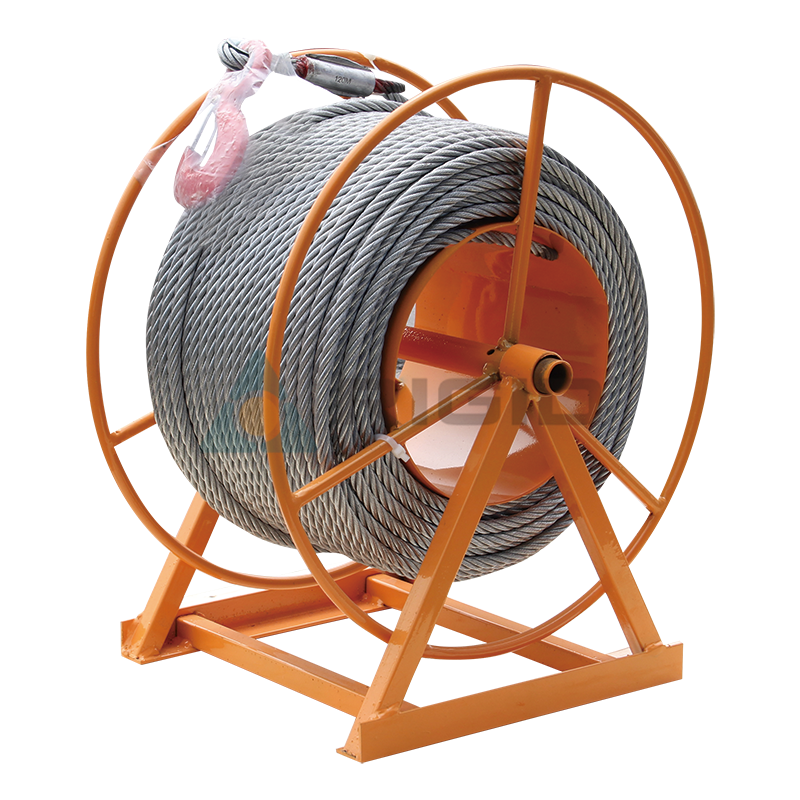
Wire Rope For Traction Hoist — Grade, Construction, And Lubrication Engineering
What Is a Wire Rope for a Traction Hoist?
A wire rope for a traction hoist is a stranded steel cable that transmits the driving force between the traction sheave and the car or counterweight, and that supports the load through friction on the sheave. It is the consumable safety element of the hoist system.
The rope is built from individual wires twisted into strands, with the strands twisted around a core to form the rope. The wire's tensile strength, the strand's construction, and the rope's lay direction determine its performance on the hoist.
Wuxi Rigid's Steel Wire Rope for Traction Hoist family covers the diameters and constructions used on the Wuxi Rigid traction hoist range.
What Are the Main Construction Types?
Wire rope construction is described by the number of strands, the number of wires per strand, and the presence of a steel or fibre core. The most common constructions on elevator traction hoists are 6×19, 8×19, and 6×36.
|
Construction |
Strand × wire |
Core |
Typical use |
|
6×19 |
6 strands × 19 wires |
Steel or fibre |
General-purpose hoisting |
|
8×19 |
8 strands × 19 wires |
Steel or fibre |
Higher fatigue resistance |
|
6×36 |
6 strands × 36 wires |
Steel or fibre |
Best flexibility, finer wires |
|
6×25 |
6 strands × 25 wires |
Steel |
Mid-range duty |
|
8×25 |
8 strands × 25 wires |
Steel |
High fatigue, larger diameter |
For elevator traction hoists, the 8×19 construction is the most common because it provides the best balance of fatigue resistance and wear resistance. The 6×36 construction is used where flexibility is critical, such as on diverter pulleys with small diameters.
What Grade of Wire Is Required?
Wire rope grade is described by the wire's tensile strength, expressed in MPa or in the older "grade" notation (e.g., 1570 MPa = 1770 N/mm² = EIPS grade). Higher grades carry more load but are less fatigue-resistant.
|
Grade |
Tensile strength |
Typical use |
|
1370 MPa |
1370 N/mm² |
Light-duty |
|
1570 MPa |
1570 N/mm² |
Standard elevator duty |
|
1770 MPa |
1770 N/mm² |
Higher load, standard fatigue |
|
1960 MPa |
1960 N/mm² |
Heavy-duty, reduced fatigue |
|
2160 MPa |
2160 N/mm² |
Highest strength, lowest fatigue |
For elevator traction hoists, the 1570 MPa and 1770 MPa grades are most common. The 1960 MPa and 2160 MPa grades are used on heavy-duty freight elevators where the higher strength is needed but the reduced fatigue life is acceptable.
Wuxi Rigid's Steel Wire Rope for Traction Hoist range is supplied in 1570 MPa and 1770 MPa grades as standard, with 1960 MPa available on request.
What Is Lay Direction and Why Does It Matter?
Lay direction is the direction in which the strands are twisted around the rope (right-lay or left-lay) and the direction in which the wires are twisted within each strand (regular-lay or lang-lay). The combination affects rope stability, fatigue, and tendency to rotate under load.
|
Lay |
Description |
Application |
|
Right regular lay (RRL) |
Strands right, wires right |
Most common, stable |
|
Left regular lay (LRL) |
Strands left, wires right |
Mirror-image installations |
|
Right lang lay (RLL) |
Strands right, wires left |
Higher fatigue, more rotation |
|
Left lang lay (LLL) |
Strands left, wires left |
Mirror-image, higher fatigue |
For elevator traction hoists, right regular lay (RRL) is the standard because it is stable under load and does not tend to rotate. Lang lay is sometimes used for higher fatigue resistance, but the rotation tendency must be controlled by the rigging.
What Finish Is Required?
Rope finish describes the surface treatment of the wires — bright (uncoated), galvanized, or stainless. The finish affects corrosion resistance and friction on the sheave.
|
Finish |
Corrosion resistance |
Friction coefficient |
Cost |
|
Bright (uncoated) |
Low |
High (≈0.20) |
Lowest |
|
Galvanized |
Medium |
Medium (≈0.15) |
Medium |
|
Stainless (304) |
High |
Lower (≈0.12) |
Highest |
|
Stainless (316) |
Highest |
Lower (≈0.12) |
Highest |
For most elevator installations, bright (uncoated) rope is the standard because the higher friction coefficient provides better traction on the sheave. Galvanized rope is used in corrosive environments (e.g., coastal sites). Stainless rope is used in food-grade or pharmaceutical applications where contamination must be avoided.
What Is the Required Rope Diameter?
Rope diameter is set by the hoist's traction sheave diameter, the rated load, and the standard's D/d ratio. Wuxi Rigid's traction hoists use the following standard diameters:
|
Hoist model |
Standard rope diameter |
|
LTD200 |
16 mm |
|
LTD50-100 |
13 mm |
|
MH40 / MH50 / MT50 |
10 mm |
Using a smaller diameter reduces rope life dramatically (fatigue life scales with the fourth power of the diameter). Using a larger diameter may not fit the sheave groove.
What Lubrication Is Required?
Rope lubrication is essential to reduce internal friction between the wires and strands, to prevent corrosion, and to extend rope life. Lubrication is applied at the factory and must be replenished during the rope's service life.
|
Lubricant type |
Base |
Application |
|
Petroleum-based |
Mineral oil |
General-purpose, low-temperature |
|
Synthetic |
Synthetic oil |
High-temperature, low-volatility |
|
Graphite-based |
Graphite + oil |
High-load, slow-speed |
|
Dry-film |
PTFE or similar |
Clean environments, low maintenance |
Wuxi Rigid's
Steel Wire Rope for Traction Hoist range is factory-lubricated with a petroleum-based lubricant suitable for general elevator duty. Re-lubrication is performed during periodic inspection using a compatible lubricant.
How Is Lubrication Reapplied in Service?
Re-lubrication is performed by dripping or brushing the lubricant onto the rope as it passes over the sheave, or by soaking the rope in lubricant during a periodic service. The frequency depends on the duty cycle and the environment.
|
Duty |
Re-lubrication frequency |
|
Light (residential, low-rise) |
Every 6 months |
|
Medium (commercial, mid-rise) |
Every 3 months |
|
Heavy (industrial, high-rise) |
Every 1–2 months |
|
Corrosive (coastal, industrial) |
Every 1–2 months |
Re-lubrication uses a lubricant compatible with the factory lubricant. Mixing incompatible lubricants can cause the factory lubricant to break down and the rope to corrode.
What Factors Affect Rope Life?
Rope life is governed by five factors: sheave diameter, rope construction, grade, duty cycle, and maintenance. Each factor contributes to the total life, and the most influential is sheave diameter.
|
Factor |
Effect on life |
Mitigation |
|
Sheave diameter |
4th-power relationship |
Use larger sheave |
|
Rope construction |
8×19 > 6×19 > 6×36 for fatigue |
Select 8×19 for cyclic duty |
|
Grade |
Higher grade = lower fatigue |
Use 1570 or 1770 MPa |
|
Duty cycle |
More cycles = faster wear |
Match rope to duty |
|
Maintenance |
Lubrication and inspection |
Disciplined inspection |
A 10% reduction in sheave diameter reduces rope life by approximately 35%. A 10% increase in load reduces life by approximately 50%. These relationships make the correct specification decisive.
How Are Ropes Terminated?
Rope terminations are mechanical devices that grip the rope end and transfer the load to the car or counterweight. The most common terminations are:
Spelter socket. The rope end is embedded in a conical socket with molten zinc or resin. Highest strength, requires skilled fabrication.
Swaged socket. The socket is mechanically pressed onto the rope. High strength, faster than spelter.
Wedge socket. The rope is wrapped around a wedge inside the socket. Lower strength, faster installation, easier to inspect.
Eye splice. The rope is looped and spliced back into itself. Used for terminations that must pass over a sheave.
Wuxi Rigid's Steel Wire Rope for Traction Hoist is supplied with swaged sockets as standard; other terminations are available on request.
What Is the Retirement Criterion?
Rope retirement follows the criteria of ISO 4309, ASME A17.1, ASME B30.5, or the equivalent national standard. Retirement triggers include broken-wire count, diameter reduction, corrosion, kinking, and birdcaging.
The most common retirement triggers:
|
Criterion |
Typical threshold |
|
Broken wires (random) |
6–12 in one rope lay |
|
Broken wires at termination |
1 within 6× rope diameter of termination |
|
Diameter reduction |
5–10% from nominal |
|
Severe corrosion |
Visible pitting over broad areas |
|
Kinking or birdcaging |
Any occurrence |
|
Heat damage |
Discoloration, melted fibers |
The Wuxi Rigid installation manual includes a rope retirement decision tree that applies the standard's criteria.
How Is Rope Storage Handled?
Rope must be stored in a dry, covered area, off the ground, and protected from chemicals and direct sunlight. Improper storage is a common cause of premature rope retirement.
Storage rules:
Store on a wooden pallet or in the original Steel Transportation Box.
Keep the rope off the ground to prevent moisture absorption.
Protect from direct sunlight, which degrades the lubricant.
Keep away from chemicals (acids, alkalis, solvents).
Rotate stock to use the oldest rope first.
A rope stored properly has an indefinite shelf life; a rope stored improperly can deteriorate in months.
What Are Common Rope Errors?
Five errors recur across installation sites; each is preventable with the standard procedure.
Wrong diameter. Substituting a smaller-diameter rope to save cost. The rope fatigues quickly and may slip on the sheave.
Wrong grade. Using a higher-grade rope (e.g., 1960 MPa) where 1770 MPa is correct. The rope fails earlier from fatigue.
Wrong construction. Using 6×19 construction where 8×19 is required. The rope's fatigue life is reduced.
Skipping re-lubrication. Allowing the rope to run dry. Internal wear accelerates and the rope retires early.
Storing rope improperly. Leaving the rope on the ground in a damp area. The rope corrodes before installation.
Each error is preventable by following Wuxi Rigid's specification, storage, and maintenance procedures.
Frequently Asked Questions
Q: What is the difference between 6×19 and 8×19 construction?
A: 6×19 has 6 strands of 19 wires each (114 wires total), with larger individual wires. 8×19 has 8 strands of 19 wires each (152 wires total), with smaller individual wires. The 8×19 has higher fatigue resistance because the smaller wires flex more easily; the 6×19 has higher wear resistance because the larger wires resist surface damage.
Q: Can galvanized rope be used on a traction sheave?
A: Yes, but the friction coefficient is lower than for bright rope. The traction calculation must account for the reduced coefficient, and a larger wrap angle or a different sheave material may be required. Wuxi Rigid can advise on traction calculations for galvanized rope.
Q: How often should the rope be replaced?
A: The rope is replaced when it reaches the standard retirement criteria (broken wires, diameter reduction, corrosion, etc.). A typical installation hoist rope may be replaced every 12–24 months; a permanent elevator rope every 5–10 years depending on duty.
Q: Can the rope be repaired if a few wires are broken?
A: No. Wire breakage is the trigger for retirement, not for repair. Continuing to use a rope with broken wires risks catastrophic failure.
Q: What is the standard rope diameter for an LTD200?
A: The standard rope diameter for the LTD200 is 16 mm, with 6×19 or 8×19 construction in 1570 MPa or 1770 MPa grade. Other diameters are available on request but may require a different sheave groove.
Q: How is rope tension measured in service?
A: Rope tension is measured with a calibrated tension gauge (a load cell or a mechanical tensiometer) at a defined position, typically just above the termination. The reading is compared to the design tension; deviations greater than 10% trigger re-termination.
Q: What is the difference between Lang lay and regular lay?
A: In regular lay, the wires in the strand are twisted in the opposite direction to the strands in the rope. In lang lay, the wires are twisted in the same direction. Lang lay has higher fatigue resistance but tends to rotate under load; regular lay is stable but has lower fatigue resistance.
Q: Can stainless steel rope be used on a standard traction sheave?
A: Yes, but the sheave material may need to be specified to match. Stainless rope on a standard steel sheave may have lower friction; stainless rope on a sheave with a compatible lining is preferred for traction.
Conclusion
Wire rope specification — grade, construction, finish, and lubrication — is the foundation of traction hoist rope life. Wuxi Rigid Machinery's Steel Wire Rope for Traction Hoist range is engineered for the LTD200 and LTD50-100 hoists and matched to the Diverter Pulley groove geometry. Correct specification, disciplined re-lubrication, and timely retirement are the practices that turn the rope from a recurring cost into a predictable line item. Pair the rope selection with the Safety Lock integration and the Authentication certificates for the destination standard.










 +86 51068080177



 Current location:Home
>News
>Industry news
Wire Rope For Traction Hoist — Grade, Construction, And Lubrication Engineering
Current location:Home
>News
>Industry news
Wire Rope For Traction Hoist — Grade, Construction, And Lubrication Engineering