False Car: The Working Platform That Replaces Scaffolding
A
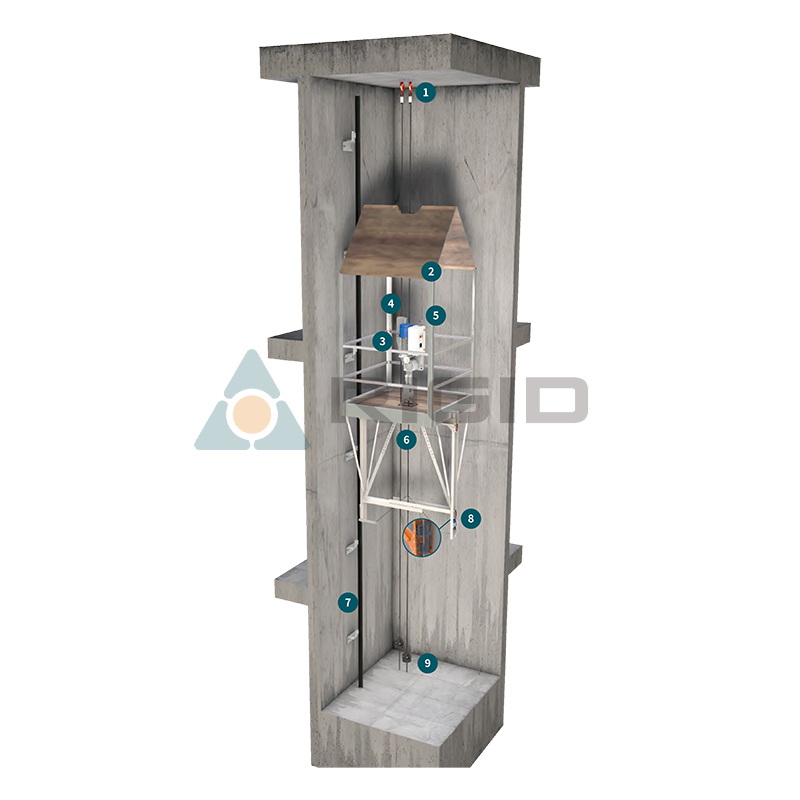
false car is a temporary platform suspended in a lift shaft and used as the working floor while guide rails, brackets and landing doors are installed. It is removed before the permanent car goes in. The name comes from that role: it is a car, but not the car.
The alternative is scaffolding erected the full height of the shaft, then struck afterwards. On a forty-storey job that is weeks of erection and dismantling, and the scaffold itself occupies the space the fitters need.
Scaffoldless installation reverses the economics. The platform climbs on its own hoist, follows the work up the shaft, and comes out at the end in an afternoon. RIGID CO., LTD. (Wuxi Rigid Machinery) in Wuxi, Jiangsu, China has built these platforms for over a decade and supplies them alongside the hoists and safety locks that drive them.
How a False Car Works
The platform hangs from a wire rope anchored at the shaft head. A rope-climbing hoist — the climber — is mounted on the platform and grips that rope. Running the climber raises or lowers the whole platform.
The Load Path
Two things follow from that arrangement. First, the platform is independent of the permanent lift machine, so installation can proceed before the machine room is commissioned. Second, the working height is set by rope length, not by a drum, so a single platform serves the whole shaft.
The platform itself is adjustable in two directions: across the shaft to suit the rail gauge, and along the shaft to suit the distance between guide rails. That adjustability is what lets one platform model cover a range of shaft sizes.
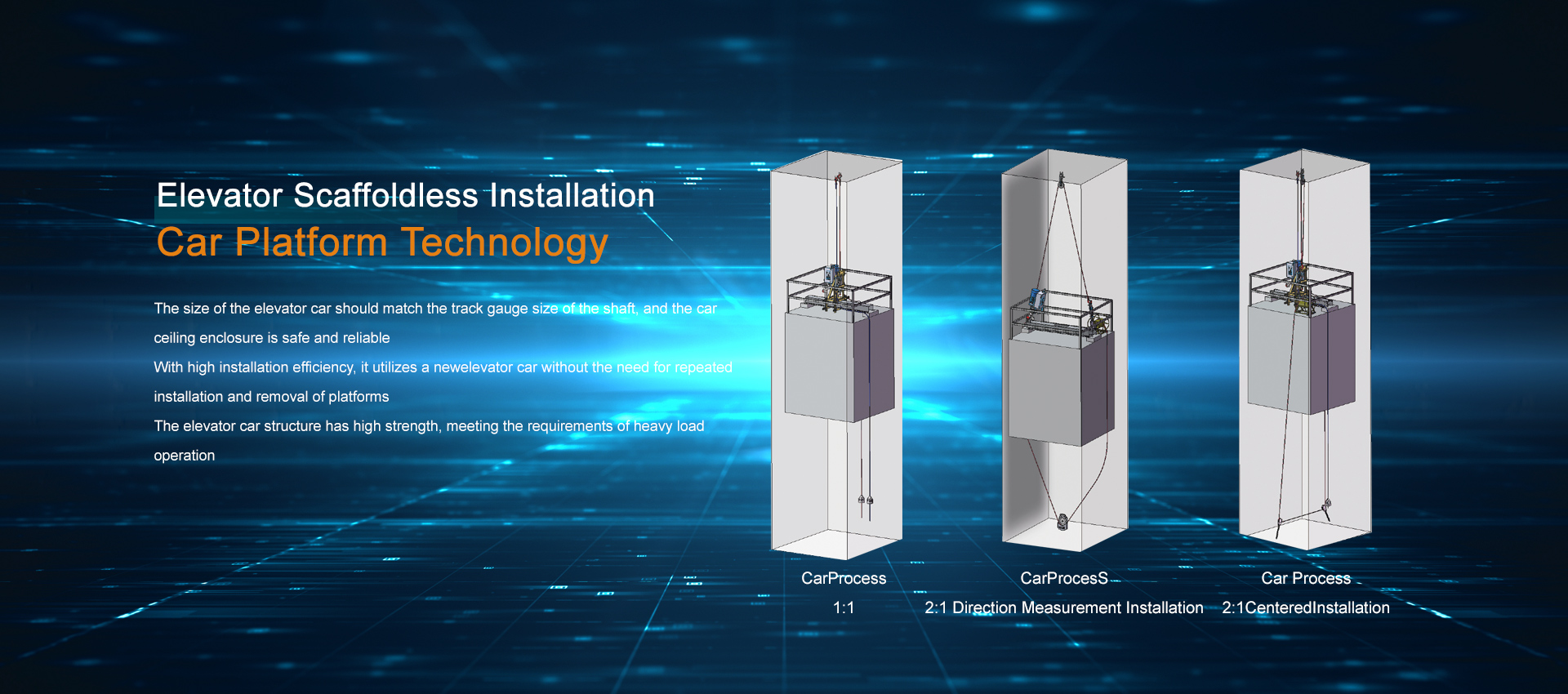
The Two Process Families: 1:1 and 2:1
The reeving decides which platform you need, and it is the first question to settle.
In a 1:1 arrangement the rope runs directly from the anchor to the climber. The platform moves at the climber's rope speed, and the load on the anchor equals the platform load plus the rope. 1:1 builds favour aluminium platforms, because the platform's own weight is carried directly and every kilogram saved is payload.
In a 2:1 arrangement the rope passes around a diverter pulley on the platform and back up to the anchor. The platform moves at half the rope speed but the rope tension doubles, and the platform needs twice the rope length. 2:1 builds favour steel platforms, because the doubled tension and heavier rail loads suit a stiffer structure.
|
Feature |
1:1 (aluminium) |
2:1 (steel) |
|
Typical platform |
FC400 series |
FC1000 series |
|
Platform dead weight |
under 200kg |
390–460kg |
|
Rated load |
400kg |
1000kg |
|
Rope length needed |
shaft height + margin |
at least 2× shaft height |
|
Rope tension |
platform load |
roughly 2× platform load |
|
Platform travel speed |
climber rope speed |
half climber rope speed |
Why the Reeving Decides the Platform
Choosing the wrong family is not a preference issue. A 1:1 platform on a 2:1 rigging has no diverter pulley and the rope path cannot be made to work.
What Is Actually on the Platform
Components, Not Options
Elevator False Car System For Lift Shafts
A
false car is an assembly, not a deck. The RIGID FC400 carries a heavy lifting hook with an aluminium swage or standard wedge socket for 1:1 work, a canopy to shed falling objects, an LTD100 multi-speed climber at 9–18 m/min, an OSL510 overspeed lock rated 1000kg on Ф10.2 rope, a safety lock adapter tying the lock into the climber, an all-aluminium work platform with a wooden floor at least 15mm thick, an anti-derailment protection system, safety tongs, and two heavy hammers that keep the lock rope hanging vertically.
The FC1000 adds a diverter pulley as standard, a high-strength steel retractable roof, an LTD100-10P18 climber running at 18 m/min, an OSL512 lock rated 1600kg on Ф11.5 rope, a rope retraction device, and a diverter counterweight that stops the rope wrapping on itself in 2:1 mode.
Matching Platform to Shaft
The selection variables are the rail gauge and the guide rail profile.
|
Model |
Rated load |
Rail spacing (DBG) |
Platform extension |
Weight |
|
FC400-A20 |
400kg |
1200–2000mm |
1500–2000mm |
150kg |
|
FC400-A26 |
400kg |
1500–2600mm |
1500–2000mm |
170kg |
|
FC400-A30 |
400kg |
1700–3000mm |
1500–2000mm |
200kg |
|
FC1000-S21 |
1000kg |
1500–2100mm |
1440–2040mm |
390kg |
|
FC1000-S27 |
1000kg |
2100–2700mm |
2040–2640mm |
460kg |
Both families accept guide rails from T75 to T78 with a K=10 bracket and T89 to T127 with K=16. If the shaft falls outside the table, the answer is usually a different platform size rather than a modified one.
Note that the FC1000 weight figures exclude the hoist, the wire ropes and the power cable. A platform quoted at 390kg will weigh noticeably more once dressed, and the suspension point has to allow for it.
Safety Architecture
A
false car for personnel carries two independent means of fall protection, and this is the requirement that separates a real platform from a site-built one.
The first is the overspeed safety lock on the platform's own safety rope. It is centrifugal: exceed the set speed — 30 m/min, or 42 m/min on some models — and hardened jaws grip the rope within a short distance.
The second is the safety tong assembly on the guide rail. Before work starts, the tongs are manually set to the normally-open position. If the climber rope loses tension, the tongs close on the rail and hold the platform. That covers the failure mode the overspeed lock cannot: the working rope itself.
A third layer is the anti-derailment system. A switch mounted on the platform, wired into the climber control box, cuts the hoist if the platform lifts off the guide rail.
Setting Up on Site
The sequence that avoids most problems:
1. Confirm the suspension point and the rope anchor are rated for the loaded platform
2. Set the platform gauge to the shaft's rail spacing and lock the extension
3. Fit the safety tongs to the rail and set them normally open
4. Prove the overspeed lock by lifting and releasing under load
5. Check the anti-derailment switch operates the climber cut-out
6. Confirm the wooden deck is at least 15mm (FC400) or 18mm (FC1000) and undamaged
Training and Support
RIGID supplies professional training and guidance with its false car platforms, which matters because the two-arrest system depends on correct setting rather than on the hardware alone. The company also holds TUV and SGS CE certification across the range, has led and participated in drafting GB 40160-2021 and GB 19155-2017, and exports to nearly 70 countries.
For platform selection, send RIGID the shaft rail gauge, guide rail profile and required load at +86 510 6808 0177.










 +86 51068080177




 Current location:Home
>News
>Industry news
False Car: The Working Platform That Replaces Scaffolding