Fall Arrest On A Suspended Platform: Why One Device Is Not Enough
Fall arrest on a suspended platform is not a product you add at the end of the specification. It is an architecture, and the architecture has one rule: no single failure may result in uncontrolled descent.
That rule is why a compliant platform carries two independent arrest systems, and why a platform with one very good lock is still not compliant.
This article sets out how the layers divide the work, what each one catches, and how to inspect a system so the inspection actually proves something. Reference equipment comes from RIGID CO., LTD. (Wuxi Rigid Machinery) in Wuxi, Jiangsu, China.
The Failure Modes You Are Arresting Against
Four things can go wrong on a rope-suspended platform, and they are not the same problem.
The hoist can fail — brake slip, motor fault, drive sheave wear to the point where grip is lost. The platform descends faster than commanded, but the rope is intact.
The rope can fail — broken wires, corrosion, mechanical damage, or a rope that was never the right diameter for the sheave. Now there is nothing to descend on.
The suspension can fail — anchor, beam or diverter pulley gives way. The whole rope path goes slack or falls.
The platform can leave the rail — lateral displacement during a rail lift, which is a different geometry failure again.
Four Failures, Four Responses
One device cannot cover all four. That is the entire argument for layered protection.
Layer One: The Overspeed Lock
Load Fall Arrest Anti-fall Systems for Elevators
The
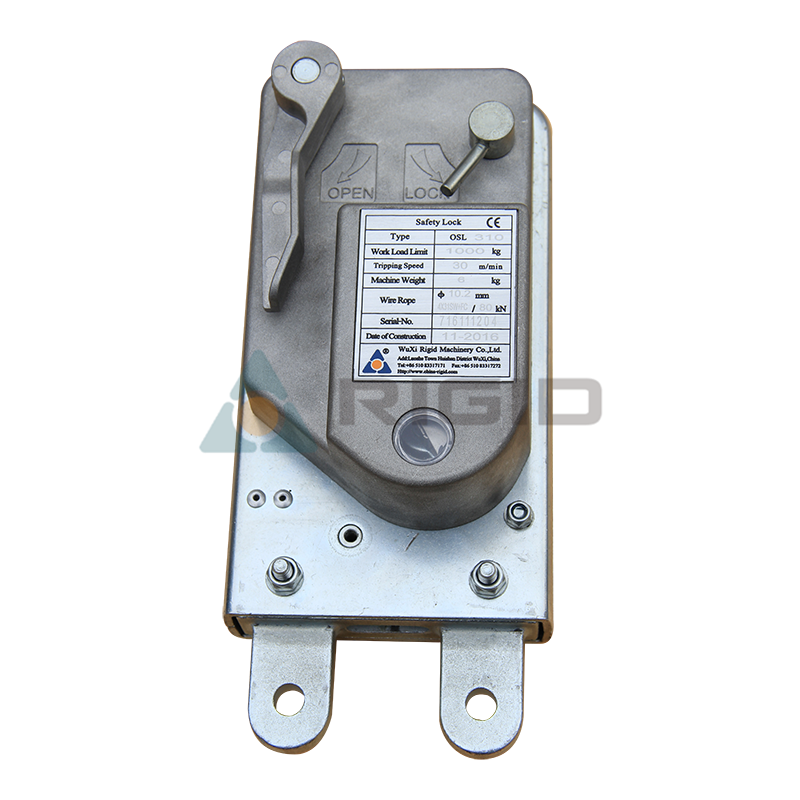
overspeed safety lock handles the first failure mode. It runs on its own safety rope, independent of the working rope, and triggers centrifugally when descent speed exceeds its set point.
On RIGID OSL units the set point is 30 m/min, or 42 m/min on some models, against normal working speeds of 9 to 18 m/min. The jaw is hardened steel and stops the rope within about 200mm on the OSL30 series.
Why the Lock Can Be Trusted
Two design details make this layer trustworthy. It needs no power, so an electrical failure does not disable it. And it uses a separate rope, so a problem with the working rope does not affect it.
The lock is passive protection in the strict sense: the operator does nothing, and the device responds to the condition rather than to a command.
Layer Two: Safety Tongs on the Rail
The second layer handles the rope and suspension failures, which the overspeed lock cannot address because those failures remove the rope the lock grips.
Safety tongs are a mechanical assembly mounted on the platform that closes onto the guide rail. They are set to the normally-open position manually before work begins. If the climber rope loses tension — hoist failure, rope failure, anchor failure — the tongs close and hold the platform on the rail.
The Setting That Gets Skipped
That is why the pre-use setting of the tongs is a critical step and not a formality. Tongs left in the closed position lock the platform before it moves; tongs left incorrectly adjusted do not close when needed. On RIGID platforms the setting is a deliberate manual action, and the training that comes with the platform covers it.
Layer Three: The Anti-Derailment Interlock
The third layer is electrical rather than mechanical. A switch on the platform bears against the guide rail and is wired into the climber control box. If the platform lifts or shifts off the rail, the switch opens and the climber stops.
This is not an arrest device. It removes the driving force before the geometry gets worse, which is often enough to prevent the situation that would need arrest.
What a Complete System Looks Like
|
Failure mode |
Layer that responds |
Type |
|
Hoist overspeed or brake slip |
Overspeed safety lock |
Passive mechanical |
|
Working rope failure |
Safety tongs on guide rail |
Passive mechanical |
|
Suspension or anchor failure |
Safety tongs on guide rail |
Passive mechanical |
|
Platform lifts off rail |
Anti-derailment switch |
Active electrical cut-out |
|
Operator error or obstruction |
Emergency stop on handle |
Active manual |
Three of the five responses are passive. That ratio is deliberate: the failures that matter most happen too fast for a person to react.
Personal Fall Arrest Is a Separate Question
A platform's arrest systems protect the platform. They do not replace personal protective equipment, and the two are not interchangeable.
Where a platform has guardrails on all sides, the residual fall risk is at the access point and during rail handling. That is where a personal fall arrest system — harness, lanyard and a properly rated anchor — is used. The anchor must be independent of the platform's own suspension, otherwise a platform failure takes the anchor with it.
Buyers sometimes ask whether the overspeed lock can serve as the personal fall arrest device. It cannot. It is a platform-level device with a platform-level rating, and its certification refers to the equipment, not to a person.
Inspection That Proves Something
A tick-box inspection of a fall arrest system proves that somebody walked past it. Four checks prove more.
Prove the lock under load. Lift the platform, release, and confirm the lock engages. A lock that is never tested is a lock whose condition is unknown.
Check rope through the
lock. Broken wires, flattening, corrosion and lubricant condition over the working length. RIGID notes that rope lubricant is consumed in service and contaminants adhere to the surface, so cleaning and re-lubricating on a regular schedule is part of keeping the rope in condition.
Confirm tong setting. Both tongs normally open, correctly adjusted to the rail, before every setup.
Apply a proof load where required. RIGID supplies a connecting chain for pulling test as an accessory, so a static proof load can be applied through a rated component rather than improvised with slings.
After any arrest event, the device that fired is withdrawn until inspected. A lock that has gripped a rope under load has done its job once, and the jaw and the rope section it gripped both need examination.
Standards Behind the Architecture
The layered approach is not a manufacturer's preference. EN 1808 for suspended access equipment, GB 19155-2017 for temporarily installed suspended access equipment and GB 40160-2021 for elevator installation lifting appliances all treat redundant arrest as a requirement rather than an option.
RIGID participated in drafting GB 40160-2021 and GB 19155-2017, and holds TUV and SGS CE certification including dedicated certificates for the centrifugal lock and the anti-tilt lock.
Specifying Fall Arrest as a System
Ask three questions of any supplier: which device responds to a working rope failure, which responds to a hoist overspeed, and how is each one tested before first use. A supplier who answers only the second has supplied half a system.
RIGID builds the locks, the tongs, the platforms and the ropes as one range, so the interfaces are the manufacturer's responsibility rather than the buyer's. Contact +86 510 6808 0177 to specify a complete arrest arrangement for your shaft.










 +86 51068080177




 Current location:Home
>News
>Industry news
Fall Arrest On A Suspended Platform: Why One Device Is Not Enough