Powerlifter For Rails: Lifting Guide Rails Without Scaffolding
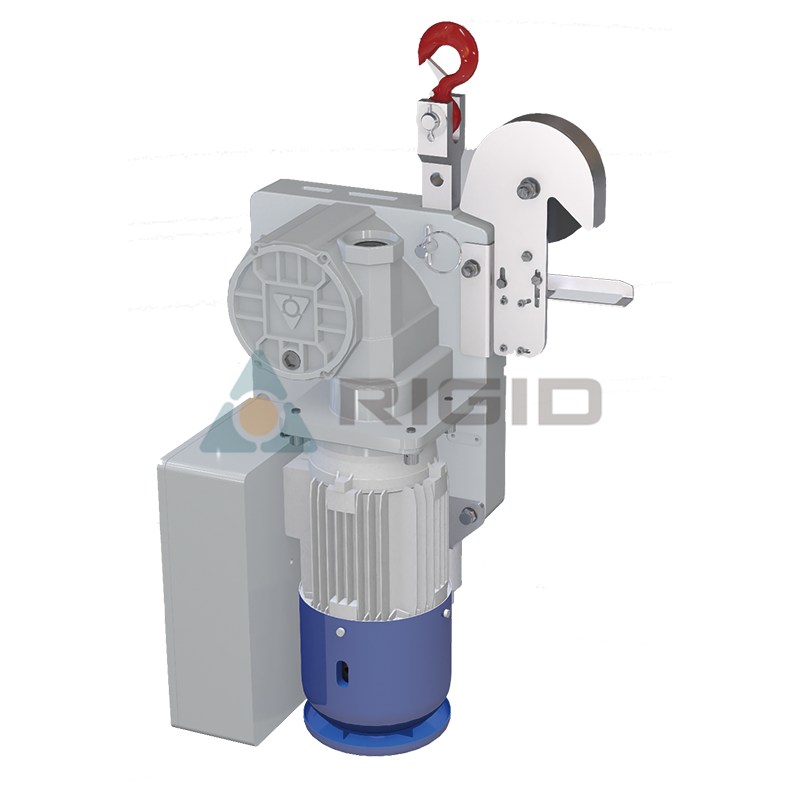
A powerlifter for rails is the machine that takes a guide rail from the landing to its bracket height inside the shaft. It is a narrow, specific job, and it has its own equipment category: the rail lifting hoist.
The alternative is a chain block and a lot of people, or a scaffold that exists only to give those people somewhere to stand. Neither scales to a tall shaft, and both slow down the rail line — which is the critical path in most installations.
This article covers the duty, the load limits, the control options and the power question, using the rail lifting and material hoist range from RIGID CO., LTD. (Wuxi Rigid Machinery) in Wuxi, Jiangsu, China.
What the Job Actually Demands
Guide rails arrive at the landing in lengths that are long, slender and awkward. A T89 rail section weighs in the region of 30 to 40kg per metre depending on profile and wall thickness, so a five-metre section is a few hundred kilograms of off-centre mass.
Three properties matter in the machine that lifts it.
Slow, controllable movement at the top of the lift. A rail has to be presented to its bracket, not thrown at it.
A suspension point that can be moved. Rail brackets are at intervals up the shaft, so the lifting point has to move with the work.
Nothing that needs a scaffold. The whole value of the equipment disappears if it requires a working platform to operate.
The Rail Lifting Hoist
RIGID's rail lifting hoists are designed to lift elevator guide rails quickly and conveniently inside a shaft, usually suspended from steel wire ropes. They are operated by wireless remote control, which means the operator can stand where they can see the bracket rather than where the machine is.
The category is described as the most adaptable device for shaft lifting, with wire rope anti-detachment protection, an optional single-phase supply for temporary power, and a position as the preferred lifting equipment in frameless — machine-room-less — elevator installation.
Wireless remote range is up to 300 metres on the units where it is offered. That is far more than a shaft requires; the point is that the signal does not depend on line of sight through a crowded shaft.
Load Limits and Model Choice
The material lifting hoists in this family top out at 500kg working load, which covers rail sections, brackets and the smaller shaft components. Lifting speed reaches 18 m/min on the faster units.
|
Model |
Capacity |
Lifting speed |
Rope diameter |
Weight |
Supply |
|
LTD50-8M9 |
500kg |
9 m/min |
8.3mm |
68kg |
400V/3ph/50Hz |
|
LTD50-8M9VF |
500kg |
9 m/min |
8.3mm |
68kg |
230V/1ph/50Hz |
|
MT509 |
500kg |
9 m/min |
8.3mm |
82kg |
400V/3ph/50Hz |
|
MT518 |
500kg |
18 m/min |
8.3mm |
82kg |
400V/3ph/50Hz |
|
MH402 |
400kg |
18 m/min |
8.3mm |
68kg |
400V/3ph/50Hz |
The MT models include a wire winder, which is the difference between a bare hoist and a unit that can manage its own rope. On a shaft job the winder earns its weight: rope that is not managed becomes rope that is walked on, kinked and inspected twice as often.
Two Suspension Approaches
Single Point
A single suspension point above the rail line is the simpler arrangement. The hoist hangs from a beam or a bracket, the rope drops to the rail, and the operator walks the load up.
Double Head
The MH40 uses a double head suspension, which doubles lifting efficiency by working two lifting points. It also allows guide pulleys to be configured so hanging points can be set flexibly — useful where the shaft head has obstructions and a single central suspension is not available.
The MH402 runs at 18 m/min with a 400kg working load on 8.3mm rope, and suits both machine-room and machine-room-less shafts.
The Power Question
Shaft power during installation is temporary and often single-phase. That single fact rules out a lot of equipment.
RIGID builds the material and rail hoists for 300V or 400V, single or three phase, 50Hz, with other voltages and frequencies available on request. The LTD50-8M9VF variant runs on 230V single phase, which is what a site usually has before the distribution board is live.
Motor protection is IP55 as standard. On a shaft that is being grouted and cleaned, dust and water jets are normal conditions rather than exceptions.
Preventing Rope Detachment
The MT50 material hoist carries upper and lower limit protection specifically to prevent the wire rope from falling off — the failure that turns a lifting job into a rope recovery job halfway up a shaft.
Why Remote Operation Changes the Risk
That protection matters more on rail work than on platform work because the hoist is operated remotely. The operator is watching the rail, not the machine, so the machine has to protect itself at the limits.
Rope Condition Is the Real Limit
The 8.3mm rope on these units has a minimum breaking force of 49.4kN, and it is the component that wears fastest. RIGID notes that rope is lubricated at manufacture, the lubricant is consumed in service, and contaminants adhere to the surface — causing abrasion between rope and sheave and eventual corrosion.
On rail work the rope runs over the same short length repeatedly, so wear concentrates. Cleaning and re-lubricating on a regular schedule, and inspecting for broken wires over the working length, is what keeps a 500kg rating meaningful.
Choosing Between Rail Lifting and Material Lifting
The two duties overlap but are not identical. Rail lifting wants slow control and a movable suspension point. Material lifting wants speed and rope management, because it moves many small items rather than a few long ones.
Where the rail line is the critical path, a powerlifter for rails that travels with the work pays for itself inside one shaft. A site that installs rails and then moves brackets, doors and counterweight frames will usually want both, or a unit that covers both duties with the right rope management.
Material Hoists & Lifts For Construction
RIGID builds the
rail lifting hoists, the material hoists and the accessory range — diverter pulleys, pulley hooks, reversing counterweights, rope tension weights, base line racks and pneumatic spring triggers — as one family, holds TUV and SGS CE certification including dedicated certificates for the MT material machines, and exports to nearly 70 countries.
Send RIGID your rail profile, shaft height and available power at +86 510 6808 0177 for a rail lifting recommendation.










 +86 51068080177


 Current location:Home
>News
>Industry news
Powerlifter For Rails: Lifting Guide Rails Without Scaffolding