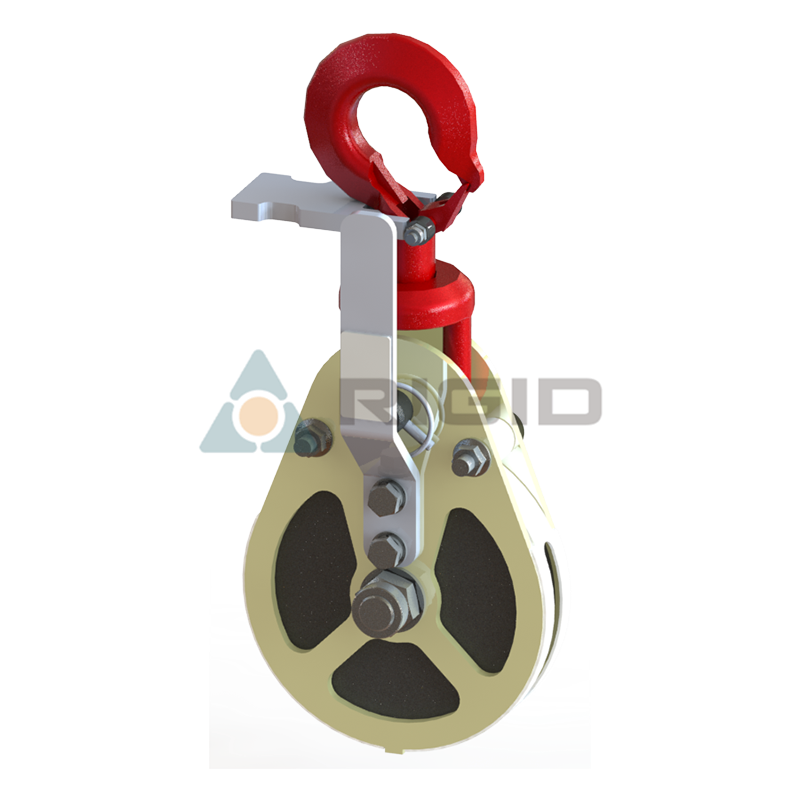
Diverter Pulley Selection, Alignment, And Rope Wear In Elevator Hoists
What Does a Diverter Pulley Do in an Elevator Hoist?
A diverter pulley redirects the wire rope between the traction sheave and the car or counterweight, increasing the sheave's effective wrap angle without enlarging the sheave itself. It is a load-bearing sheave that runs at the same surface speed as the rope.
In a single-wrap traction hoist, the rope wraps the sheave through approximately 180°. In a double-wrap or "double-belted" arrangement, a diverter pulley redirects the rope so it wraps the sheave through 270° or more. The extra wrap increases the traction (the friction force that prevents rope slip on the sheave) without requiring a larger sheave.
The diverter pulley is not just a redirector — it is a precision component that must:
Match the rope diameter to a specific groove profile.
Resist wear on the groove from rope contact pressure.
Maintain alignment to within tight angular tolerances over its service life.
Run balanced to avoid vibration and rope "dancing" across the groove.
What Is the Difference Between a Diverter Pulley and a Traction Sheave?
The traction sheave is the drive sheave, powered by the motor; the diverter pulley is an idler sheave, driven only by rope tension. Both are precision-machined, both contact the rope under load, but they play different roles.
|
Component |
Role |
Load |
Failure consequence |
|
Traction sheave |
Motor-driven; transmits power to the rope |
Full rope tension × wrap-angle friction |
Rope slip, traction loss |
|
Diverter pulley |
Idler; redirects the rope |
Full rope tension (each side) |
Rope wear, alignment drift, vibration |
|
Deflector sheave |
Idler; supports rope without load-bearing redirect |
Rope tension only |
Rope wear, groove damage |
The diverter pulley sees the same rope tension as the traction sheave but does no work. Its job is to redirect the rope accurately and survive the wear.
What Diameter Should a Diverter Pulley Be?
Diverter pulley diameter is governed by the rope diameter and the standard's D/d ratio, not by the available space. The D/d ratio (sheave diameter divided by rope diameter) is the controlling parameter for rope fatigue life.
|
Standard |
Minimum D/d ratio (traction) |
Minimum D/d ratio (diverter) |
|
EN 81-20 |
40 (passenger), 30 (goods) |
30 |
|
ASME A17.1 |
30 (most elevators) |
25 |
|
GB 7588 |
40 |
30 |
|
Installation hoist (typical) |
25–30 |
20–25 |
A 16 mm rope on an installation hoist with a 25 D/d ratio requires a 400 mm diverter pulley. Undersized pulleys reduce rope fatigue life by an order of magnitude. The Wuxi Rigid Diverter Pulley range is sized to provide at least 25 D/d for the Steel Wire Rope for Traction Hoist diameters it is paired with.
What Groove Profile Is Required?
The diverter pulley's groove profile must match the rope's nominal diameter with the correct undercut and groove angle to support the rope without crushing it. The groove geometry has three critical dimensions:
Groove radius. Equal to or slightly larger than the rope's nominal radius (typically R = 0.53 × rope diameter).
Groove angle. Typically 35°–45° inclusive, allowing the rope to seat without binding.
Flank clearance. Allowing the rope to flex slightly without contact on the flanks during normal operation.
|
Groove parameter |
Typical value |
Effect of deviation |
|
Groove radius |
0.53 × d (rope dia) |
Rope crushing or rope "jumping" |
|
Groove angle |
35°–45° |
Premature rope wear or groove-edge spalling |
|
Flank clearance |
1–2 mm |
Rope binding or excessive wear |
A new groove is verified by a profile gauge; an in-service groove is verified by a profile trace at each periodic inspection. The Wuxi Rigid pulleys are supplied with profile certifications to the specified standard.
How Should a Diverter Pulley Be Aligned?
The diverter pulley must be aligned so the rope tracks centrally in the groove across the full load range; angular misalignment greater than 0.5° causes accelerated rope and groove wear. Alignment has three components:
Axial alignment. The pulley's axis must be parallel to the sheave's axis (or to the rope's nominal plane) within ±0.5 mm per metre of shaft length.
Angular alignment. The pulley's plane must be in the rope's plane of motion; deviation causes the rope to climb one side of the groove.
Height alignment. The pulley's centreline must be at the design height; deviation changes the wrap angle on the sheave and the rope angle on the car.
Alignment is checked with a laser alignment tool or a precision level. A misaligned pulley is the most common cause of asymmetric rope wear on installation hoists and the easiest to correct.
What Causes Rope Wear on a Diverter Pulley?
Rope wear on a diverter pulley is caused by misalignment, undersized diameter, worn groove, contamination, or under-tensioned rope — and is most often a combination of two or more. Each cause has a recognizable signature:
|
Wear pattern |
Likely cause |
|
Uniform across the rope width |
Normal service wear; track periodically |
|
One-sided wear |
Angular misalignment of the pulley |
|
Localized bright spot on rope |
Pulley diameter too small; high contact pressure |
|
Flank wear on rope |
Groove angle too tight or rope too large |
|
Birdcaging at the pulley |
Shock load or sudden tension change |
Tracking the wear pattern over time, on the same rope sample, is more informative than a single snapshot. Photographs at each periodic inspection, with consistent lighting and a reference scale, allow a clear trend to be reconstructed.
What Is the Maintenance Schedule for a Diverter Pulley?
Diverter pulley maintenance is scheduled by hours of operation, by load cycles, and by visual inspection triggers — and is more frequent on installation hoists than on permanent elevators. The schedule below is a starting point; site-specific conditions may require more frequent checks.
|
Task |
Frequency |
Inspector |
|
Visual inspection (rope tracking, groove wear) |
Daily |
Operator |
|
Profile gauge check |
Monthly |
Trained inspector |
|
Alignment verification |
Quarterly |
Trained inspector |
|
Bearing inspection (noise, temperature, lubrication) |
Quarterly |
Trained inspector |
|
Groove re-machining or replacement |
As needed; typically 2–5 years |
Manufacturer or qualified machine shop |
The Wuxi Rigid Diverter Pulley range is supplied with a maintenance schedule matched to the specific rope diameter and expected duty.
How Are Diverter Pulley Bearings Sized?
Diverter pulley bearings are sized for the radial load (rope tension × wrap angle factor) plus a margin for shock loads and misalignment. Bearing life is calculated by the standard L10 rating (the hours at which 10% of bearings will have failed).
The radial load on each bearing is:
F_r = rope tension × sin(θ/2) for a redirecting pulley, where θ is the wrap angle change.
For an installation hoist with rope tension 3000 daN and a 90° redirect, the radial load is approximately 2120 daN per bearing. A standard deep-groove ball bearing (e.g., 6308) at this load has an L10 life of 20,000–40,000 hours, which exceeds the typical deployment duration of an installation hoist.
Sealed bearings are preferred for installation hoists because the shaft environment is dusty and the bearing is harder to re-lubricate. The Wuxi Rigid pulleys use sealed bearings as standard.
How Does Diverter Pulley Condition Affect Rope Life?
Diverter pulley condition is one of the two largest factors in rope fatigue life (the other is sheave diameter). A rope that runs over a worn, misaligned, or undersized pulley will retire early even if every other condition is ideal.
The relationship is exponential: a 10% reduction in pulley diameter reduces rope fatigue life by approximately 30%. A 0.5° misalignment reduces rope life by approximately 25%. Combined, a worn and misaligned pulley can cut rope life by more than half.
The practical implication is that pulley maintenance pays for itself many times over by extending rope life. A pulley that costs USD 500 can save several rope changes per year on a busy installation hoist.
What Are Common Diverter Pulley Errors?
Five errors recur on installation hoist deployments. Each is preventable with the standard inspection routine.
Undersized diameter. Selecting the smallest pulley that fits the available space, ignoring the D/d requirement. Always check the standard before ordering.
Ignoring wear. Continuing to use a pulley with a visibly worn or stepped groove. The rope wears faster, and the noise increases.
Loose mounting. The pulley frame is not bolted tightly enough to the machine beam; vibration loosens it further and accelerates wear.
No alignment check. Installing the pulley and assuming the geometry is correct. A 30-second laser alignment check prevents weeks of accelerated wear.
Wrong groove profile. Using a pulley from a different rope-diameter hoist. Always match the groove to the rope.
How Does Wuxi Rigid Match Pulleys to Hoists?
Wuxi Rigid matches each pulley to the rope and hoist combination, with documented compatibility tables for the Steel Wire Rope for Traction Hoist range and the LTD200 and LTD50-100 hoists. Each pulley ships with a serial-numbered identification plate and a profile certificate.
The selection process:
Identify the rope diameter and construction from the hoist data sheet.
Identify the wrap angle and required D/d ratio from the installation geometry.
Select the pulley from the Wuxi Rigid catalogue with the corresponding part number.
Confirm compatibility with the hoist's machine beam mounting pattern.
If the catalogue does not include a part for the specific combination, Wuxi Rigid offers custom pulleys with a typical 4–6 week lead time.
What Documentation Should Ship with Each Pulley?
Each diverter pulley should ship with a profile certificate, a material certificate, a balance test record, and a bearing specification. The site file retains these plus the maintenance log over the pulley's service life.
|
Document |
Purpose |
|
Engineering drawing (GA) |
Dimensional reference for installation |
|
Profile certificate |
Confirms groove geometry meets standard |
|
Material certificate |
Confirms pulley material (typically QT600-3 ductile iron or equivalent) |
|
Balance test record |
Confirms dynamic balance to G6.3 or better |
|
Bearing specification |
Replacement part reference |
The Wuxi Rigid Diverter Pulley catalogue includes the documentation pack template so procurement teams know what to expect.
Frequently Asked Questions
Q: Can a worn diverter pulley groove be re-machined?
A: Yes, if the wear is within the re-machining allowance (typically the groove can be re-cut up to two times before the pulley must be replaced). The re-machining must be done by a qualified machine shop with a profile tracer and a CNC lathe or mill. After re-machining, the pulley must be re-balanced and the profile re-certified.
Q: How often should the diverter pulley be re-balanced?
A: A new pulley is balanced at the factory to G6.3 or better. In service, the bearing condition is the largest variable; if the bearings are replaced, the pulley should be re-balanced. After any impact (e.g., rope jump or shock load), the pulley should be inspected and re-balanced if necessary.
Q: What causes rope "dancing" across the pulley groove?
A: Rope dancing (the rope moves back and forth across the groove during operation) is caused by misalignment, by an unbalanced pulley, by a worn groove, or by excessive rope tension variation. Each cause has a different correction; the first step is always to verify alignment with a laser tool.
Q: Can the diverter pulley be made of polyurethane or composite instead of metal?
A: Polyurethane linings are used in some permanent elevators to reduce noise and vibration, but they are not standard on installation hoists because the higher cycle rate and rougher environment wear the lining faster. Metal pulleys with proper groove geometry are the default; composite or lined pulleys are available for noise-sensitive sites.
Q: How is the diverter pulley aligned to the traction sheave?
A: Both sheaves are set on a common machine beam; alignment is verified by a laser alignment tool that measures the parallelism of the two shafts within ±0.5 mm per metre. The tool also measures angular deviation, which is corrected by shimming the pulley frame.
Q: What is the difference between a diverter pulley and a deflector sheave?
A: A diverter pulley is a load-bearing idler sheave that redirects the rope with a significant wrap-angle change (typically 60°–180°). A deflector sheave is an idler sheave that supports the rope without a significant angle change, used to route the rope around a corner of the machine beam or counterweight frame.
Q: What is the typical service life of a diverter pulley on an installation hoist?
A: With proper maintenance, the pulley body has a service life of 5–10 years. The bearings typically require replacement at 3–5 year intervals, and the groove may require re-machining or replacement at 2–5 year intervals depending on duty. The Steel Wire Rope wears out faster than the pulley if both are correctly specified and maintained.
Conclusion
Diverter pulley selection, alignment, and maintenance are decisive factors in rope life, traction, and noise on any installation hoist. The Wuxi Rigid Diverter Pulley range is matched to the Steel Wire Rope for Traction Hoist diameters and to the LTD200 / LTD50-100 traction hoists. Correct specification (D/d ratio, groove profile, bearing life) and disciplined alignment pay back many times over by extending rope life and reducing downtime. Pair the pulley with the hoist sheave of matching diameter and consult the Authentication page for the certificate set relevant to the destination standard.










 +86 51068080177




 Current location:Home
>News
>Industry news
Diverter Pulley Selection, Alignment, And Rope Wear In Elevator Hoists
Current location:Home
>News
>Industry news
Diverter Pulley Selection, Alignment, And Rope Wear In Elevator Hoists